What Exactly is a 400 Amp Service?
A 400 amp service upgrade doubles your home’s electrical capacity — from the standard 200 amps — to handle the growing demands of modern living. Here’s when it makes sense:
- You’re adding multiple EV chargers and your current panel is already close to capacity
- Your home is all-electric with heat pumps, electric water heating, and heavy appliances
- You’re over 3,500 sq ft with multiple HVAC systems running simultaneously
- You’re building a home workshop with welders, compressors, or CNC equipment
- You’re integrating solar, battery backup, or a whole-home generator
If none of those apply, a 200 amp service is likely still enough — even for larger homes.
Most Denver homes were built with 100 or 200 amp service, and for a long time, that was plenty. But things have changed fast.
Electric vehicles. Heat pumps. Smart home systems. Whole-home battery backups. What I see more and more in Denver homes is a mismatch: the appliances have upgraded, but the electrical service hasn’t.
The result? Breakers tripping. Lights flickering. Homeowners wondering if their panel can handle one more thing.
Most of the time, a 200 amp service still does the job. But when it doesn’t — when the loads genuinely stack up — a 400 amp service upgrade is worth understanding. Not just what it costs, but what it actually involves, what setup works best, and whether you really need it.
That’s exactly what this guide covers.
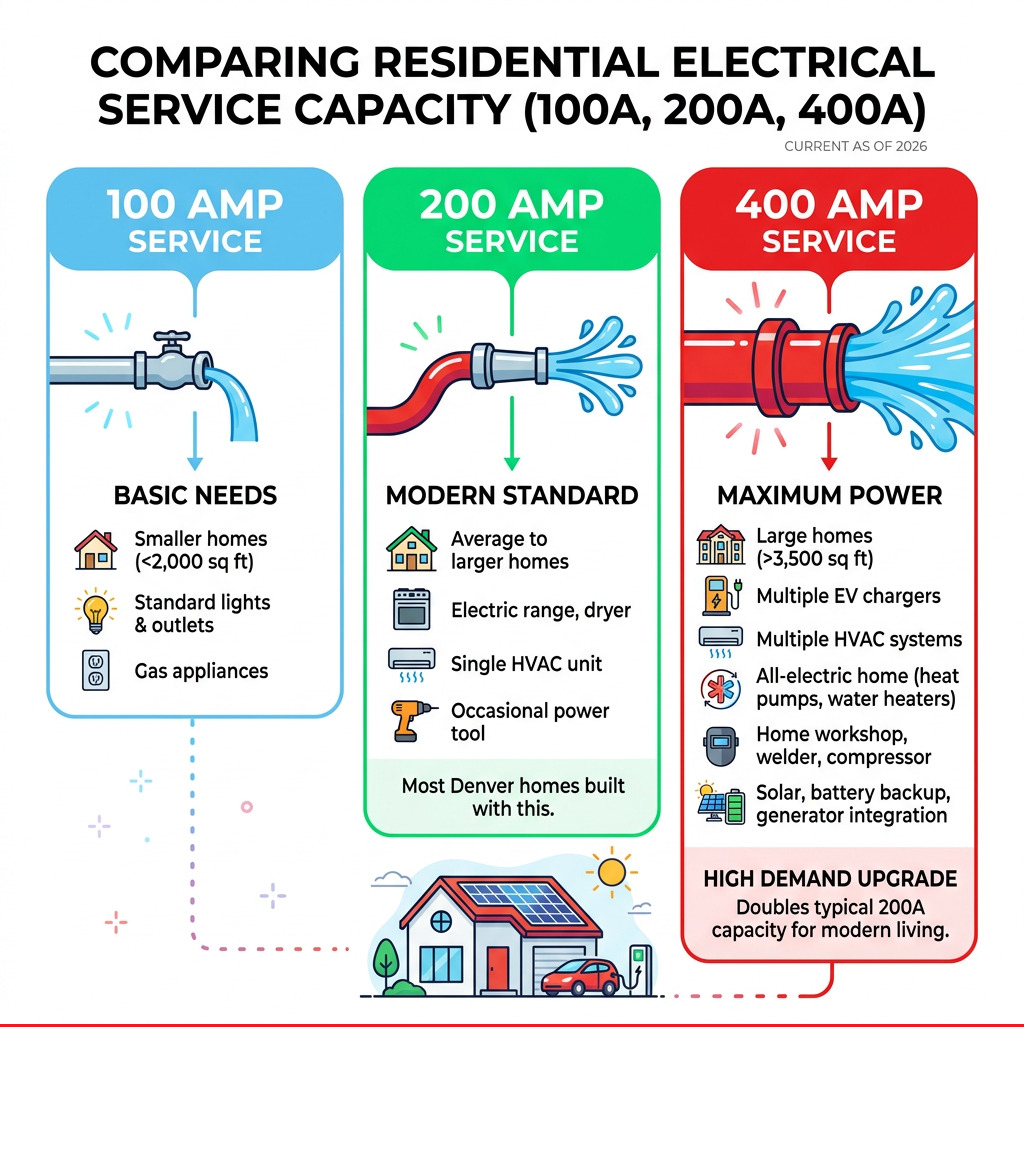
When we talk about a 400 amp service upgrade, we are talking about the total volume of electricity your home can pull from the utility grid at any one time. Think of your electrical service like a water main. A 100 amp service is like a garden hose, 200 amps is like a fire hose, and 400 amps is more like a high-pressure water main.
In technical terms, amperage measures the flow of electricity. While voltage is the pressure pushing that flow, amperage is the capacity of the “pipe” itself. In most residential settings around Denver and Castle Rock, what we call a “400 amp service” is actually a 320 amp continuous service.

Why the different numbers? Electrical components are rated for two things: peak load and continuous load. A standard “400 amp” meter socket is usually rated for 320 amps of continuous use (running for three hours or more) but can handle 400 amp surges. For almost any home, 320 amps of continuous power is an enormous amount of energy.
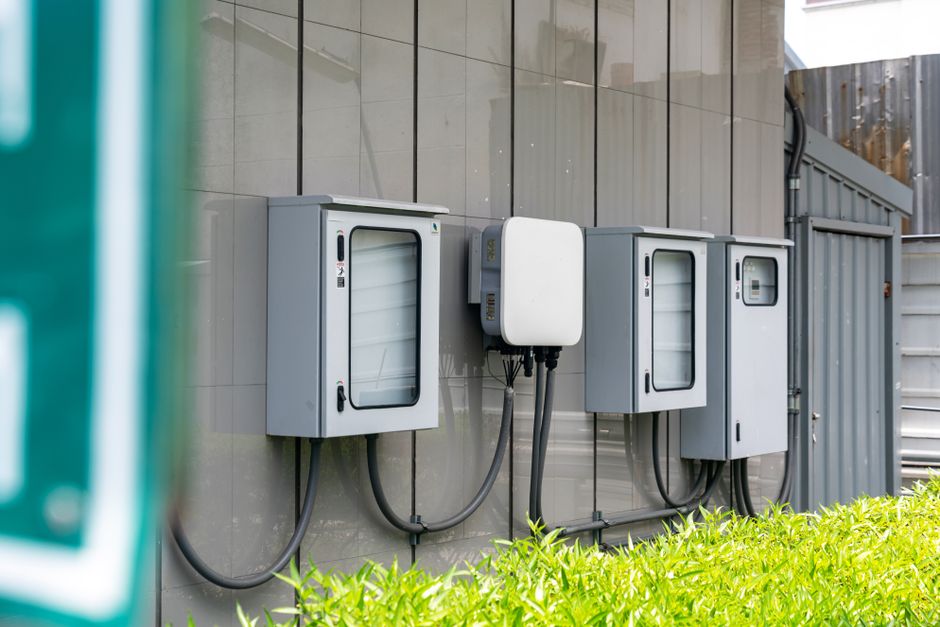
To understand what’s happening inside the box, you can check out our Inside Electric Panel Complete Guide. Generally, a Electric Panel for House use is much simpler than commercial power, but at 400 amps, we start using equipment that looks a bit more like what you’d see in a small warehouse.
| Service Size | Typical Use Case | Capacity (Watts at 240V) |
|---|---|---|
| 100 Amp | Older, smaller homes with gas heating/cooking | 24,000 Watts |
| 200 Amp | Standard modern home; supports AC and one EV | 48,000 Watts |
| 400 Amp | Large luxury homes; multiple EVs; all-electric | 96,000 Watts |
When Your Home Actually Needs a 400 Amp Service Upgrade
I’ll be honest with you: most homeowners are surprised to learn that even a 15,000-square-foot home rarely maxes out a 200 amp service. However, the “all-electric” movement is changing the math.
We see the need for a 400 amp service upgrade most often in these scenarios:
- The 3,500+ Sq. Ft. Rule: Once a home crosses this size, you usually have at least two or three air conditioning units. If you combine those with electric heating, you’re eating up capacity fast.
- The “Electric Everything” Transition: If you’ve swapped your gas furnace for a high-efficiency heat pump and your gas water heater for an electric one, your “baseload” is much higher.
- High-Demand Amenities: Can My Existing Electrical Panel Handle a Hot Tub? Usually, yes. But if you add a hot tub, a sauna, and a heated pool simultaneously, you might start pushing the limits of a 200 amp panel.
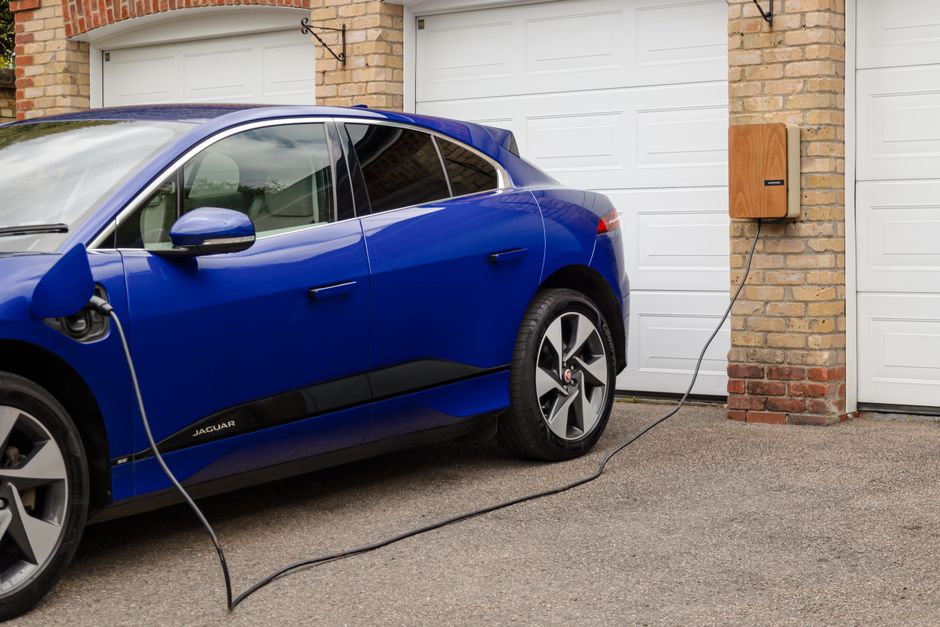
- Multiple EVs: One Tesla or Ford F-150 Lightning is fine. Two or three EVs all trying to fast-charge at 80 amps each overnight? That is the #1 reason I’m seeing people ask for Electrical Panel Upgrades in Castle Rock CO lately.
- The Home Workshop: If you’re a hobbyist with a 50 amp welder, a large air compressor, and a CNC machine, you’re essentially running a small business out of your garage.
Before you commit to an upgrade, we always perform a professional load calculation. This isn’t a guess; it’s a formula based on the National Electrical Code (NEC) that adds up your square footage and the specific “heavy hitters” in your home. You can read more about Understanding Electrical Panel Upgrades When and Why You Need One to see if your symptoms—like flickering lights or a hot-to-the-touch panel—match the need for more power.
The Best Setup: One Panel vs. Dual 200A Panels
If we decide that 400 amps is the way to go, the next question is how to “deliver” that power into the house. You might think you just buy one giant 400 amp panel. While those exist, they are rarely the best choice for a home.
In the electrical world, 200 amp equipment is a “commodity.” Because almost every house built in the last 30 years uses it, the parts are mass-produced and affordable. Once you jump to a single 400 amp panel, you enter industrial equipment.
Why dual 200A panels are the standard for a 400 amp service upgrade
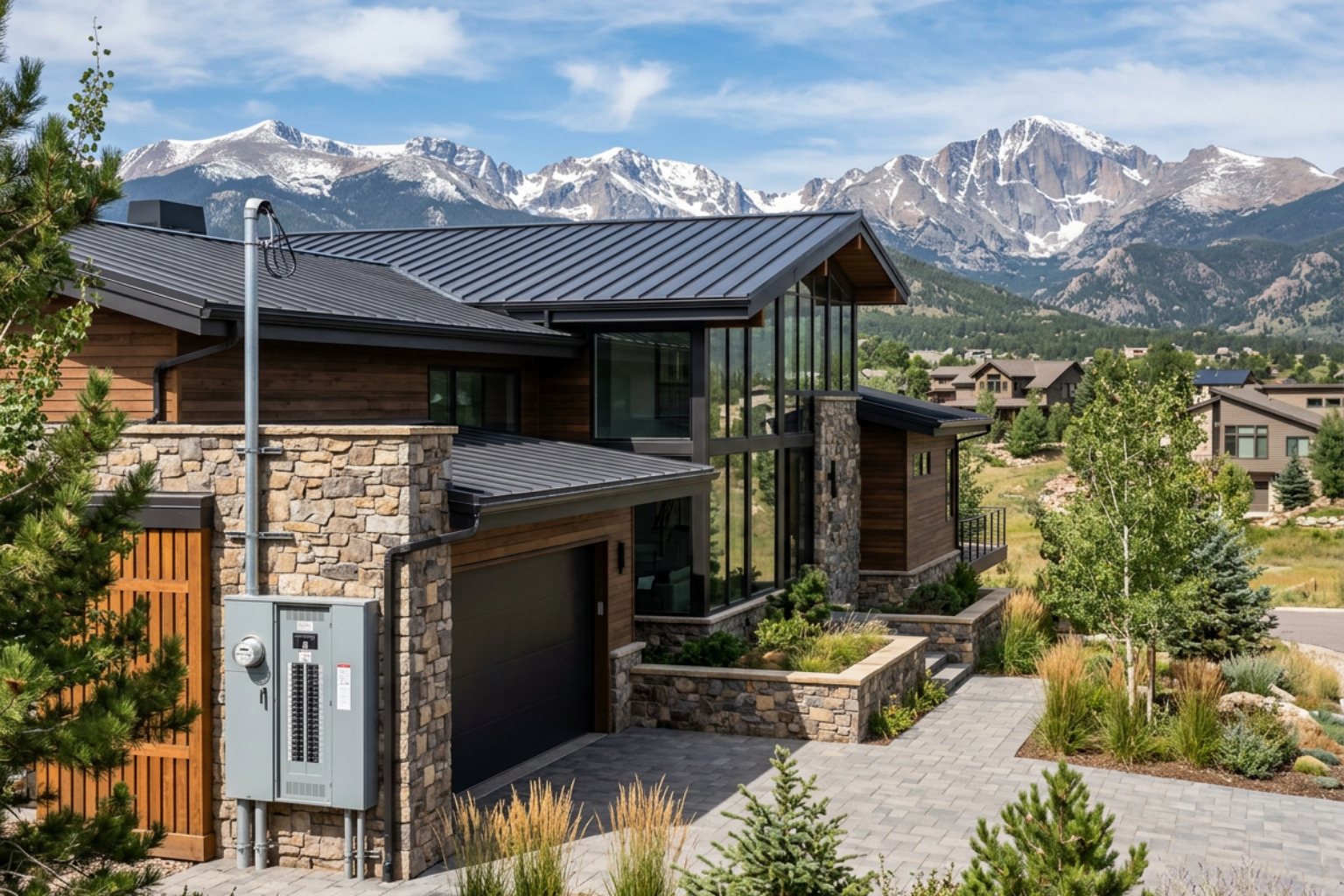
What I usually see in Denver homes is a “320/400” meter base on the outside of the house that feeds two separate 200 amp main panels inside. This is almost always the better way to go for several reasons:
- Cost-Effectiveness: A single 400 amp main breaker panel can cost four times as much as two 200 amp panels. It’s a massive price jump for the same amount of power.
- Availability: During recent supply chain crunches, 400 amp panels had lead times of several months. 200 amp panels are almost always in stock.
- Backup Power Planning: If you want a generator, a 200 amp transfer switch costs around $700. A 400 amp version can easily top $3,000. By using two panels, you can put your “critical loads” (fridge, lights, furnace) on one 200 amp panel and only back up that one, saving you thousands.
- Solar and Batteries: Most solar inverters and battery systems (like the Tesla Powerwall) are designed to integrate with 200 amp systems. Trying to hook them into a single 400 amp “beast” of a panel is much more complicated and expensive.
For a deeper dive into how these systems work together, our guide on Subpanel Secrets Everything You Need to Know for a Smooth Install explains how we distribute power from a main source to different areas of your property.
What to Expect During a 400 Amp Service Upgrade
Upgrading to 400 amps is a significant project. It’s not just a “panel swap.” It involves the utility company, the city inspector, and a lot of heavy-duty hardware.
First, we handle the Panel Circuit Upgrades Denver requirements, which include pulling permits with the local building department. We then coordinate with the utility—usually Xcel Energy in our area—to ensure their equipment can handle the draw.
The physical installation includes:
- New Service Entrance Conductors: We usually run parallel sets of 250 kcmil aluminum wires or a single set of very thick 500 kcmil copper. These are the “arteries” that bring power from the grid to your meter.
- The Meter Base: Your old meter box is removed and replaced with a larger 320A/400A rated socket.
- Grounding and Bonding: This is a safety critical step. When we do a 400 amp service upgrade, we often have to drive new ground rods and update the bonding to your water and gas lines to meet current NEC safety standards.
- The Panels: We install the dual 200 amp panels (or a single 400 amp panel if requested) and migrate all your existing circuits over.
Coordinating your 400 amp service upgrade with the utility company
One thing many people don’t realize is that the utility company (the “POCO”) has their own set of rules. Sometimes, the transformer on the street isn’t big enough to feed a 400 amp home. Xcel Energy might need to upgrade that transformer, which can add cost and time to the project.
This is why a DIY 400 amp upgrade is never a good idea. Between the utility coordination and the massive amount of current involved, it’s a job for a Master Electrician. If you’re curious about the difference between a simple fix and a full overhaul, check out Electrical Panel Replacement vs Repair.
Frequently Asked Questions about High-Amperage Upgrades
How much does a 400 amp service upgrade cost?
This is the big question. In the Denver Metro area, a standard 200 amp upgrade might cost between $3,500 and $5,500. A 400 amp service upgrade is a different animal.
Depending on the length of the wire run, whether the lines are underground or overhead, and what the utility company charges for their portion, you can expect to pay anywhere from $10,000 to $20,000. In some extreme cases where the utility has to dig a new trench or upgrade a distant transformer, we’ve seen quotes go even higher. It’s a major investment in your home’s infrastructure, but it also adds significant property value—especially for buyers looking for EV-ready homes.
Can I just add a subpanel instead of a full upgrade?
You can always add a subpanel to get more space for breakers, but a subpanel doesn’t give you more power. If your main breaker is 200 amps, that is your “speed limit.” Adding a subpanel is like adding more seats to a car; it doesn’t make the engine any stronger. If your total load calculation exceeds 200 amps, a full service upgrade is the only safe way forward.
Will this upgrade lower my monthly electric bill?
Not directly. A 400 amp panel doesn’t “sip” electricity more efficiently than a 200 amp panel. However, it allows you to install more efficient modern appliances—like heat pump water heaters or smart HVAC systems—that will lower your bill over time. It also prevents the “heat loss” that can happen when a 200 amp panel is constantly running at its absolute limit.
Conclusion
Upgrading your home to 400 amp service is about more than just being able to run the toaster and the microwave at the same time. It’s about “future-proofing.” As we move toward a world where our cars, our heating systems, and even our water heaters run on electricity, having that extra capacity means you’ll never have to worry about whether your home can keep up.
At Harmony Electric, we’ve helped countless homeowners in Denver, Castle Rock, and Highlands Ranch navigate these complex upgrades. We don’t believe in upselling you on power you don’t need, but if a 400 amp service upgrade is the right move for your family, we’ll make sure it’s done right the first time.
If you’re seeing Signs Outdated Electrical Panel or you’re planning a major renovation, give us a call. We’ll walk you through the load calculations, coordinate with the utility, and provide a clean, professional installation backed by our lifetime workmanship guarantee. Whether you’re in Centennial or Parker, we’re here to help you power your modern life safely and reliably.