Why You Need a GFCI Sub Panel for Hot Tub Safety
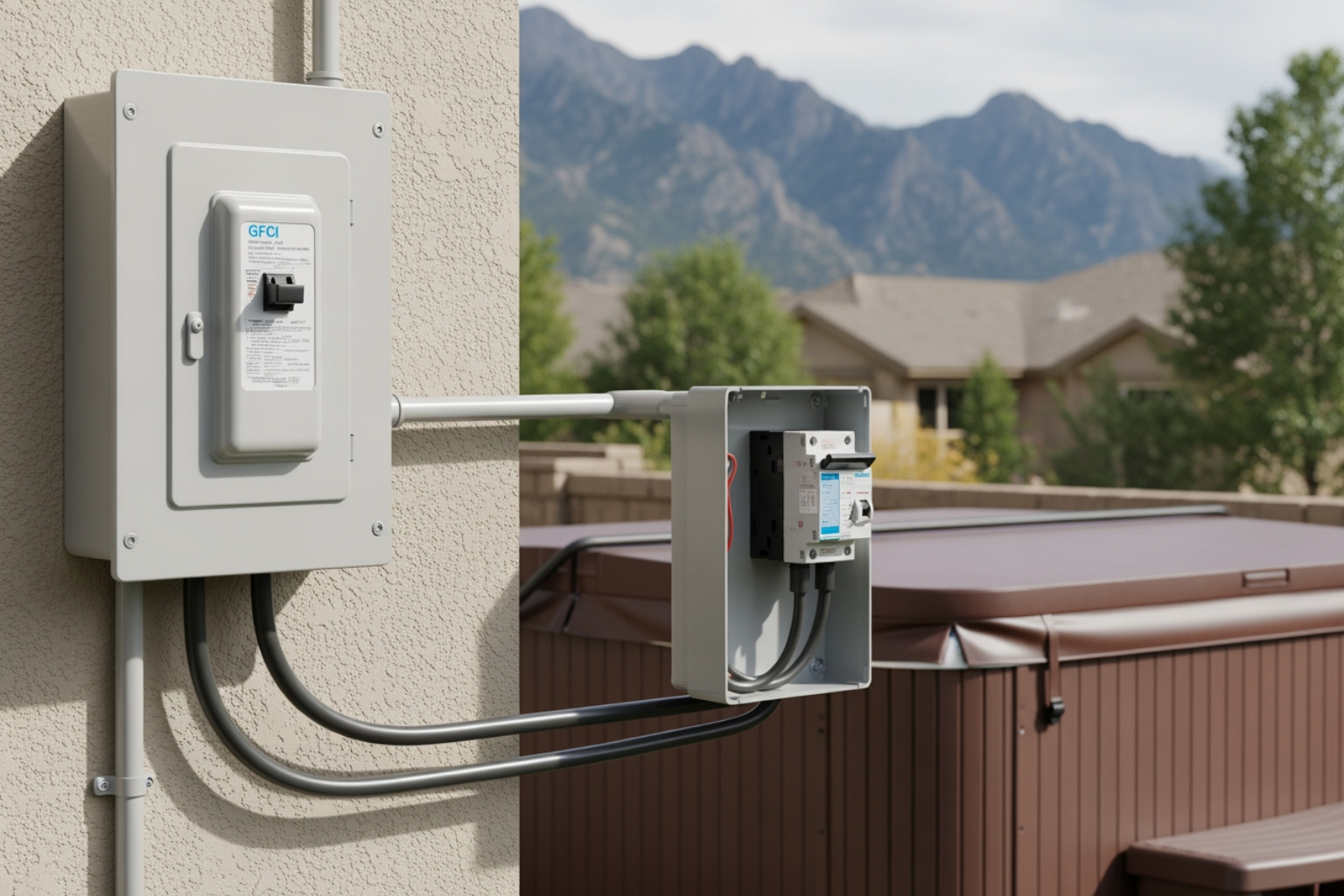
A GFCI sub panel for hot tub installations is a small, outdoor-rated electrical box that sits between your main panel and your hot tub. It contains a GFCI (Ground Fault Circuit Interrupter) breaker that acts as both a safety shutoff and shock protection device — and it’s required by code for every 240V hot tub installation.
Here’s what you need to know at a glance:
- What it does: Monitors electrical current and cuts power instantly if it detects a ground fault (an imbalance as small as 5 milliamps)
- Why it’s required: NEC Article 680 mandates GFCI protection and a dedicated disconnect for all hot tub circuits
- Where it goes: Mounted at least 5 feet from the hot tub’s inside wall, within line of sight
- Common sizes: 40A, 50A, or 60A — matched to your hot tub’s power requirements
- Who installs it: A licensed electrician (this is not a DIY project)
Water and electricity are a dangerous combination. Most homeowners are surprised to learn that it only takes 5 milliamps — roughly 1/500th of what it takes to trip a standard breaker — to cause a serious electrical shock. A GFCI sub panel is the device standing between your family and that risk every time someone gets in the tub.
Here in Denver, I’ve seen a lot of hot tub installations done without proper GFCI protection, or with the panel wired incorrectly. Both situations are serious safety hazards — and unfortunately, neither one is obvious until something goes wrong.
This guide walks you through everything: what a GFCI sub panel does, how to size it correctly, how it gets wired, and what can go wrong if it’s not done right.
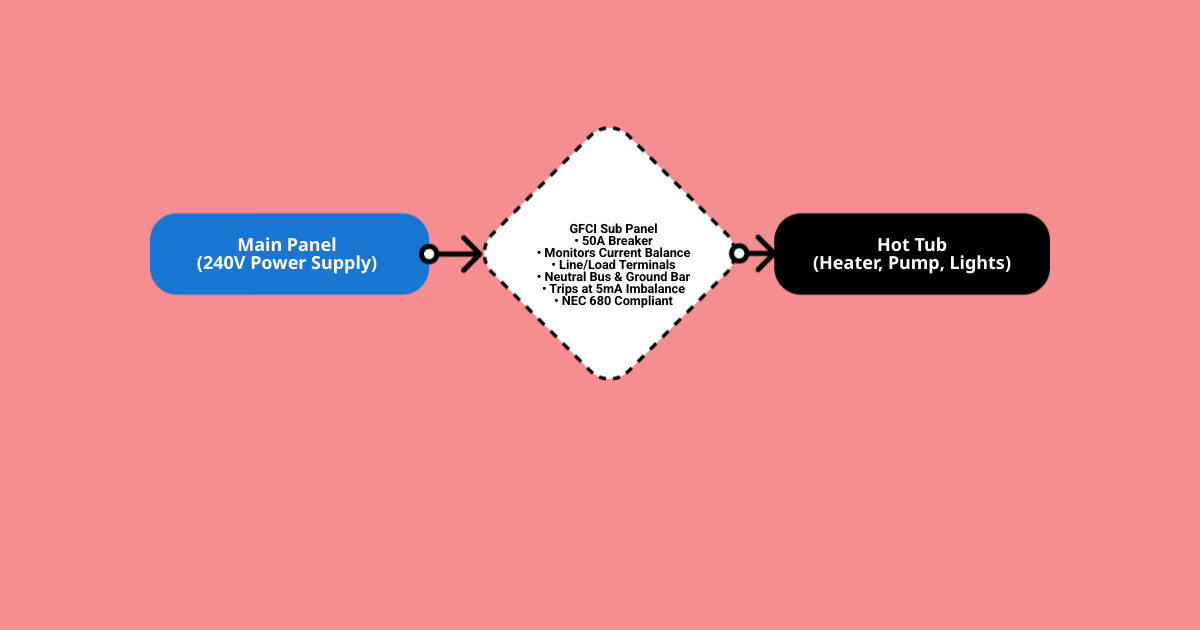
Important gfci sub panel for hot tub terms:
When we talk about the shocking truth: everything about hot tub GFCI breakers, we aren’t just using a catchy title. In the electrical world, a “ground fault” happens when electricity finds a path to the ground that it wasn’t supposed to take—like through the water or, worse, a person.
A standard breaker in your main panel is designed to protect your wires from catching fire if there’s a short circuit. It won’t trip until the current is massive. A GFCI, however, is much more sensitive. It constantly compares the electricity going out to the electricity coming back. If there is a tiny difference—as little as 5mA—it assumes that electricity is leaking somewhere dangerous and kills the power in a fraction of a second.
The National Electrical Code (NEC), specifically Article 680, is very strict about this. Every hot tub must have a GFCI sub panel for hot tub protection. Without it, a faulty heater element or a loose wire could energize the water without ever tripping a standard breaker.
Understanding the GFCI Sub Panel for Hot Tub Disconnect Rules
One of the most important parts of hot tub electrical code GFCI requirements is the “maintenance disconnect.” This is a fancy way of saying you need a switch nearby so a service technician (or you, in an emergency) can shut off the power while looking at the tub.
The rules for where we place this panel are very specific:
- The 5-Foot Rule: The panel must be at least 5 feet away from the inside wall of the hot tub. This is so you can’t be sitting in the water and reach out to touch the electrical box at the same time.
- The “Within Sight” Rule: The panel must be visible from the hot tub and no more than 50 feet away.
- Readily Accessible: You shouldn’t have to climb over a fence or move a heavy planter to get to it.
Sizing Your GFCI Sub Panel for Hot Tub Performance
Not all hot tubs are created equal. Some smaller “plug and play” models run on 120V, but most of the tubs we install in the Denver Metro area are 240V units that require a dedicated circuit.
When deciding can my existing electrical panel handle a hot tub?, we have to look at the total “load” or power draw.
- 40 Amp: Often used for smaller 240V tubs with a single pump and a smaller heater.
- 50 Amp: The industry standard. Most mid-to-large tubs require a 50A GFCI sub panel.
- 60 Amp: Used for high-end “swim spas” or tubs with three or more pumps and heavy-duty heaters.
Using a breaker that is too small will cause “nuisance tripping” every time the heater and jets turn on together. Using one that is too large (like a 60A breaker on a tub rated for 40A) is a fire hazard because the breaker won’t trip even if the tub’s internal components are overheating.
Choosing the Right Wire and Breaker Components
Once we know the amperage, we have to pick the right “straws” to move that electricity. In our experience with subpanel secrets: everything you need to know for a smooth install, using the wrong wire size is one of the most common mistakes we see.
We only use copper wire for hot tubs. Aluminum can expand and contract, leading to loose connections in the wet, outdoor environment of a spa.
| Circuit Amperage | Required Copper Wire Size (THHN) | Grounding/Bonding Wire |
|---|---|---|
| 40 Amp | #8 AWG | #10 AWG (Insulated) |
| 50 Amp | #6 AWG | #8 AWG (Solid Copper) |
| 60 Amp | #6 AWG | #8 AWG (Solid Copper) |
For a standard 50A gfci sub panel for hot tub setup, we typically run #6 AWG THHN copper conductors. These are individual wires pulled through a conduit, not the Romex (NM-B) wire you find inside your walls.
Proper Conduit and Burial Depths
Since the wire is going outside, it needs a tough “home.” We use Schedule 40 or 80 PVC conduit for most of the run. According to hot tub electrical installation hookup GFCI standards, if you are burying this conduit in your yard, it needs to be at least 18 inches deep.
When the conduit comes out of the ground and connects to the hot tub, we use a short length (usually 6 feet or less) of “liquid-tight” flexible conduit. This allows for a little bit of movement as the tub settles or vibrates when the pumps are running.
Step-by-Step: How to Wire Your Spa Panel
Wiring a gfci sub panel for hot tub is different than wiring a standard outlet. It’s a “sub-panel,” which means it has its own set of rules for how the wires connect.
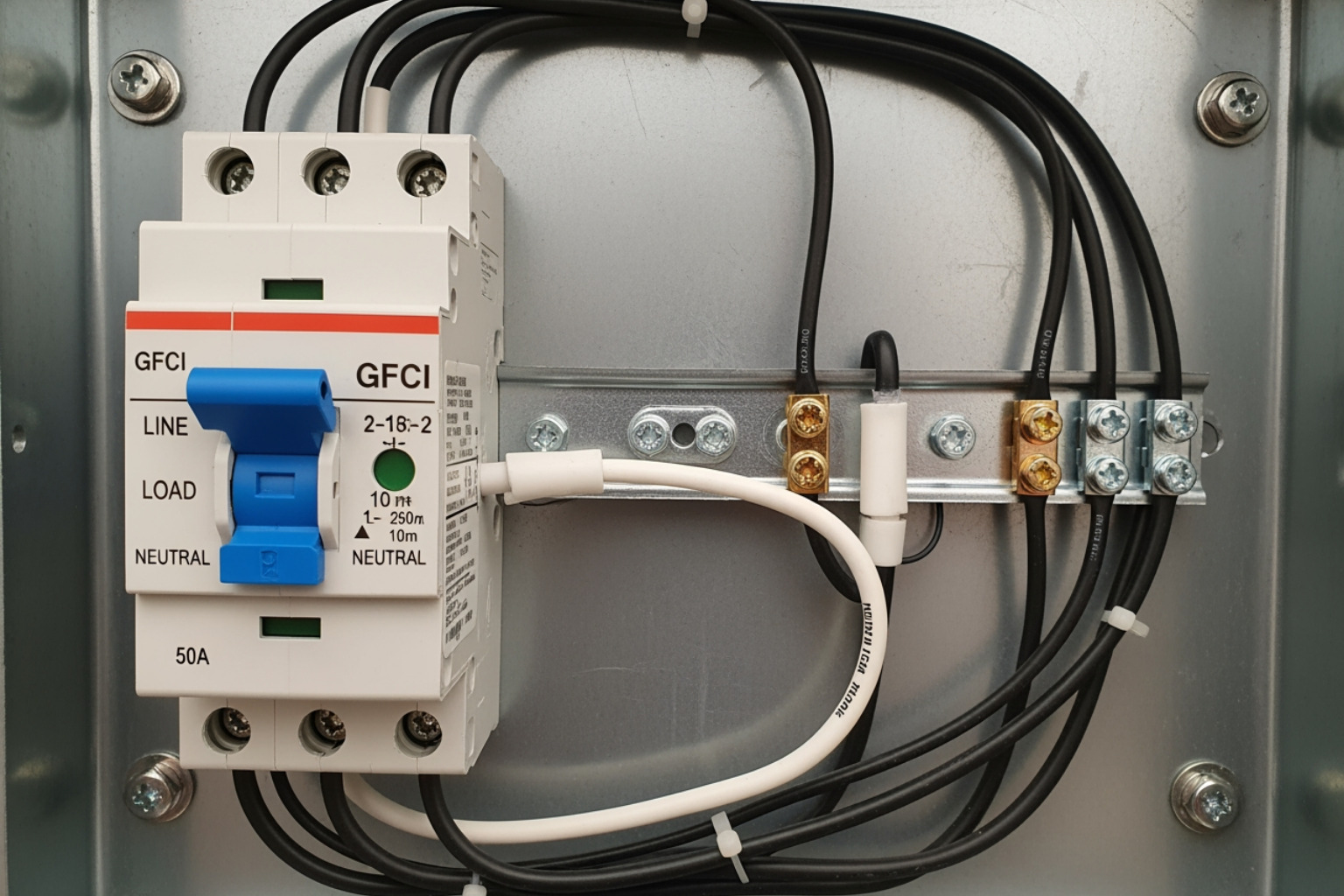
Here is the general flow of a professional installation:
- The Feed: We run four wires from your main house panel to the sub-panel (two hots, one neutral, and one ground).
- Line Side: The two hot wires connect to the “Line” lugs on the top of the GFCI breaker. The neutral wire from the house connects to the neutral bus bar.
- The Pigtail: This is the part people miss. The GFCI breaker has a white “pigtail” wire curled up on it. This must be connected to the neutral bus bar of the sub-panel.
- Load Side: The wires going out to the hot tub connect to the bottom of the breaker. Crucially, the white neutral wire from the hot tub must connect directly to the breaker, not the bus bar.
- Grounding: All ground wires connect to a separate ground bar that is bonded to the metal box.
We always follow the easy way to safety by ensuring that the neutral and ground are never bonded (connected) together in this sub-panel. They must stay separate all the way back to the main house panel.
Avoiding Common GFCI Sub Panel for Hot Tub Wiring Mistakes
I’ve spent a lot of time in Castle Rock and Parker fixing DIY hot tub wiring mistakes. The most dangerous one is the “Neutral-to-Ground Bond.” In your main panel, these two are often on the same bar. In a sub-panel, if you connect them, you create a “loop” that can cause your GFCI to trip constantly or, in some cases, fail to trip when it should.
Another common error is the 4-wire vs. 3-wire hookup. Some older spas only used two hots and a ground. Modern spas almost always use a 4-wire system (two hots, a neutral, and a ground) to power 120V lights or ozonators. If you try to wire a 4-wire tub to a 3-wire feed, the GFCI will trip every time you turn on a light.
Troubleshooting and Maintenance for Longevity
Even a perfectly installed gfci sub panel for hot tub can have issues over time. If your breaker starts tripping, it’s usually telling you something is wrong.
- Nuisance Tripping: This often happens because of moisture. If a conduit fitting isn’t tight, Colorado’s snow and rain can get inside. We also see “nuisance” trips caused by loose lugs. Over time, the heat from the electricity can cause wires to slightly expand and loosen.
- The Heater Element: This is the #1 cause of GFCI trips. If the heater element gets a tiny crack, water touches the electrical coil inside. The GFCI senses that tiny leak and shuts everything down.
- The Test Button: You should press the “Test” button on your GFCI once a month. It’s a mechanical device, and parts can seize up if they aren’t moved. If you press it and it doesn’t click off, the breaker has failed and needs to be replaced.
When wiring a home hot tub, we always check the voltage at the panel. You should see 240V across the two hot wires and 120V from either hot to the neutral or ground.
Frequently Asked Questions about Hot Tub Wiring
Can I put the GFCI in my main panel instead of a sub-panel?
Technically, yes. If your main panel is within sight of the hot tub and at least 5 feet away, you can use a GFCI breaker there. However, we usually recommend a sub-panel. It’s much more convenient to reset a breaker 10 feet away from the tub than it is to run into the garage or basement in your swimsuit.
How far exactly should the panel be from the water’s edge?
The NEC says at least 5 feet. There is no “maximum” distance as long as it is “within sight” (usually interpreted as 50 feet). In most Highlands Ranch or Centennial backyards, we find that 6 to 10 feet is the “sweet spot” for convenience and safety.
Why does my breaker trip only when the jets are on?
This usually indicates a “ground fault” in the pump motor. When the motor starts, a small amount of electricity is leaking to the frame of the pump. It could also mean your wire is undersized, causing a voltage drop that creates an amperage spike beyond what the breaker can handle.
Conclusion
Installing a gfci sub panel for hot tub is about more than just getting the jets to turn on—it’s about making sure your backyard remains a place of relaxation, not a safety hazard. Between the specific burial depths, the wire sizing, and the complex internal wiring of the GFCI itself, there are a lot of ways for a “DIY” weekend project to go sideways.
At Harmony Electric, we’ve handled hundreds of hot tub installations across the Denver Metro area, from Castle Pines to Lone Tree. We believe in doing the work right the first time, which is why we back our hot tub wiring with a lifetime workmanship guarantee.
If you’re getting ready to install a new spa or your current breaker is giving you trouble, give us a call. We’ll make sure your power is safe, code-compliant, and ready for you to soak in peace.