Start With the Right 50 Amp Hot Tub Wiring Plan
A typical 50 amp hot tub wiring diagram starts with a dedicated 240V double-pole 50A GFCI breaker, then runs to a weatherproof spa disconnect, and finally to the hot tub control pack. Most newer full-size tubs use four conductors: black and red hot wires, a white neutral, and a green insulated ground.
Before any wire is pulled, check the hot tub’s installation manual. It tells you whether the tub needs a neutral for 120V items such as lights or an ozonator. In most Denver-area installations, I see #6 copper conductors in outdoor-rated conduit, with the disconnect placed in sight of the tub but at least 5 feet from its inside wall.
Water changes the stakes. A dedicated GFCI-protected circuit, correct neutral connection, and proper grounding are what keep the system working without nuisance trips.
I’m Randy Harmuth, Master Electrician and owner of Harmony Electric, and the next sections break down this wiring path in plain English.
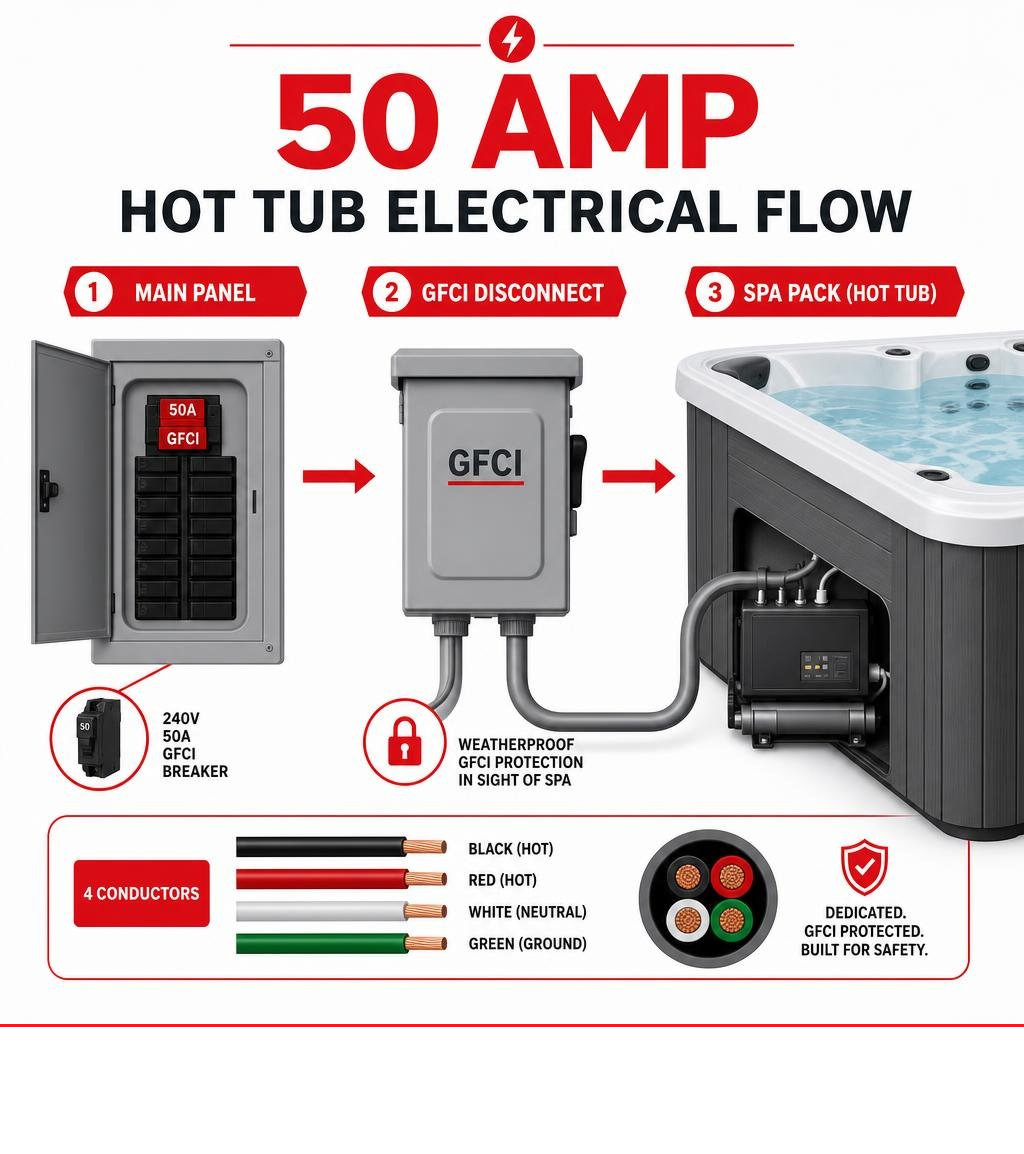
Discover more about 50 amp hot tub wiring diagram:
Understanding the 50 Amp Hot Tub Wiring Diagram
Reading an electrical plan can feel intimidating when you look at all the lines and symbols.
In reality, a residential hot tub circuit is a straightforward, closed loop. It takes high-voltage power from your house and routes it safely to the spa pack in your yard.
Because water and electricity are close neighbors here, this circuit needs specialized protection at every point.
Reading the 50 Amp Hot Tub Wiring Diagram for 240V Circuits
Every 240V circuit uses two hot legs that carry 120 volts each. When combined, they deliver the full 240 volts needed to run heavy equipment like electric heaters and multi-horsepower jet pumps.
On the diagram, you will notice a clear distinction between the “line” side and the “load” side.
The line side refers to the incoming power coming directly from your home’s main panel. The load side refers to the outgoing wires feeding power to the spa control pack.
Understanding how these connections interface with your breaker is essential, which we cover in detail in our guide on how to Power Up Safely: Your 50-Amp Hot Tub GFCI Wiring Diagram.
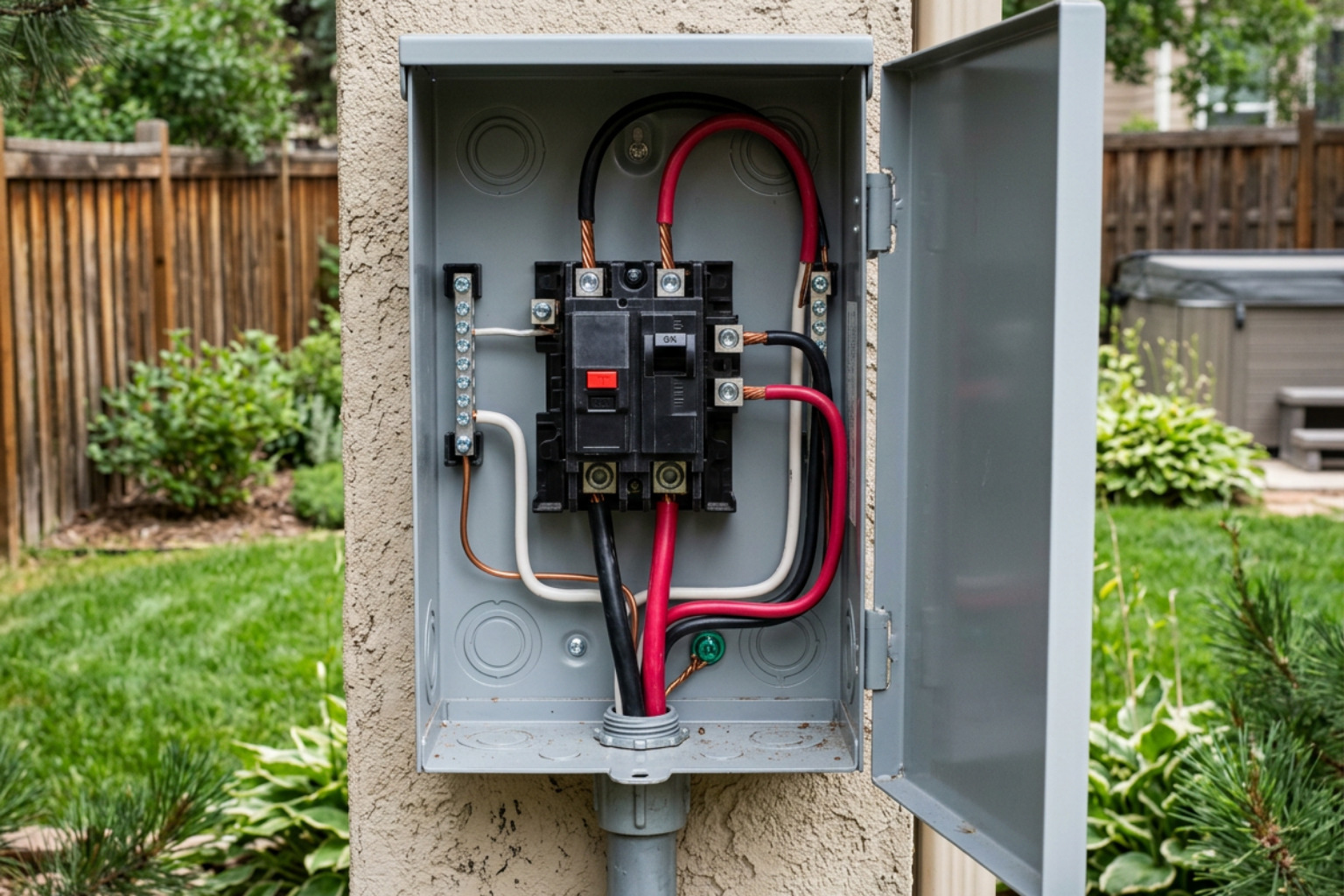
A standard double-pole breaker connects across two separate bus stabs in your panel. This gives you balanced 240-volt power.
If either side experiences an electrical fault, both poles trip simultaneously to completely cut power to the backyard.
Key Components from Main Service Panel to Spa Pack
Before setting up your spa, you need to know if your electrical service has enough breathing room.
Most modern homes feature 150-amp or 200-amp service panels. However, older homes in the Denver area might still operate on 100-amp panels that are already near capacity.
It is always smart to evaluate Can My Existing Electrical Panel Handle a Hot Tub? before buying equipment.
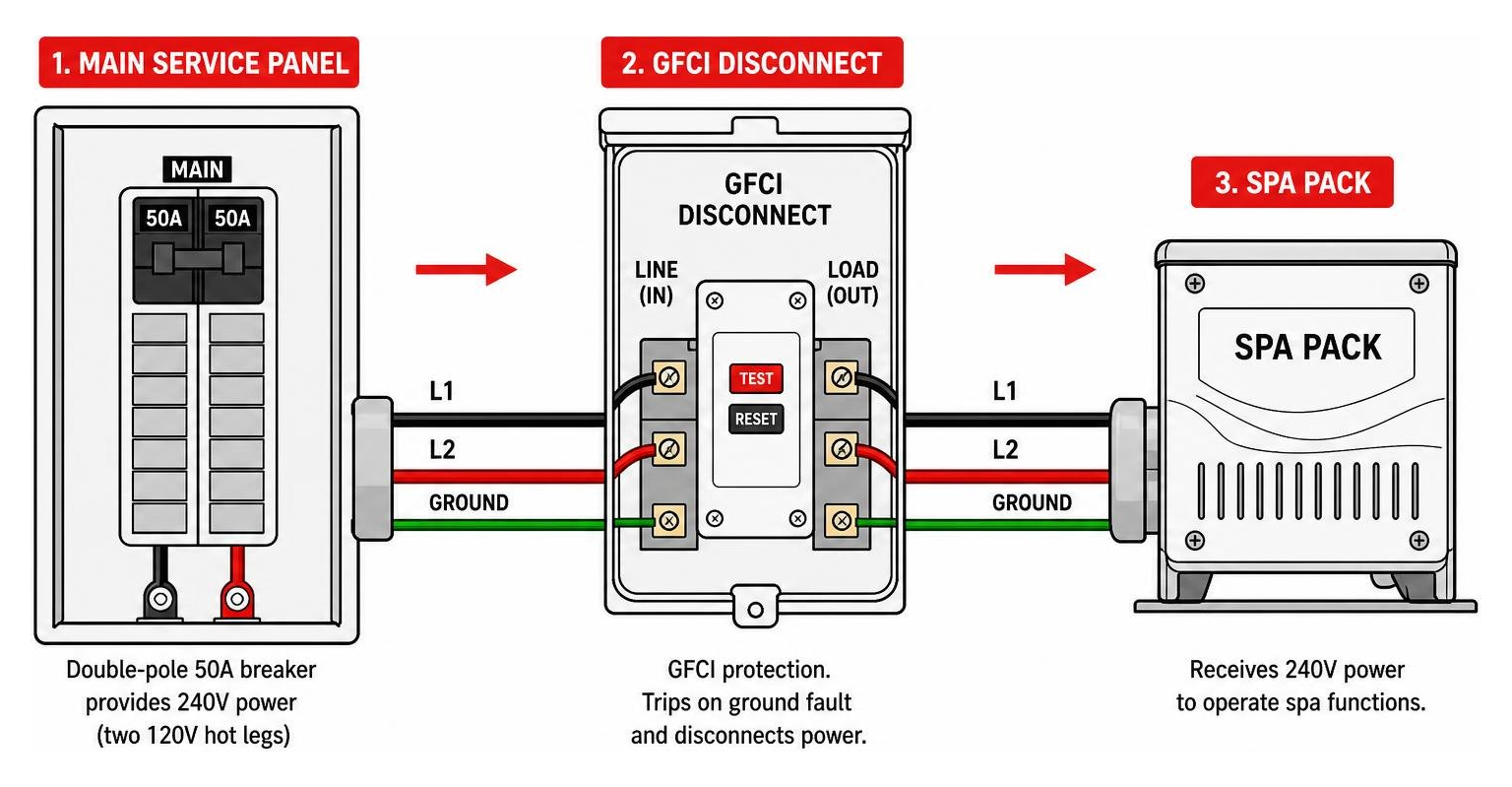
Here is a quick look at the main components in a standard 50-amp setup:
| Component | Primary Function | Location |
|---|---|---|
| Main Service Panel | Supplies raw household power | Basement, garage, or exterior wall |
| 50A 2-Pole Breaker | Overcurrent protection for feeder wires | Inside main service panel |
| GFCI Disconnect Subpanel | Emergency shutoff and ground-fault safety | Outdoors, 5 to 50 ft from hot tub |
| 50A GFCI Breaker | 5mA ground fault sensing mechanism | Mounted inside the outdoor disconnect box |
| Spa Control Board (Pack) | Distributes power to heater, pumps, lights | Inside hot tub maintenance cabinet |
Each part of this chain serves as a layer of protection to keep your equipment running smoothly and safely.
Essential Wire Sizing and Conduit Requirements for 50-Amp Spas
Getting the wire size right is one of the most critical steps in any hot tub installation.
Undersized wire generates excess heat, causes voltage drops, and can burn out expensive pump motors prematurely.
6 AWG vs 8 AWG Copper Wire Sizing and the 80 Percent Rule
For a dedicated 50-amp circuit, we run 6 AWG copper conductors with THHN/THWN insulation.
While 8 AWG copper wire is sometimes rated for up to 50 amps at higher temperature ratings, hot tubs represent a continuous electrical load.
When a spa runs its 4 kW or 5.5 kW heater alongside multiple jet pumps for hours, continuous current rules apply.
We always explain What Wire Do You Need for Your 220V Hot Tub? A Comprehensive Breakdown so owners understand why 6 AWG is the standard.
Following recognized technical wire sizing guidelines ensures your conductors stay cool under continuous load.
Copper is the only material we use for spa wiring. Aluminum wire expands and contracts more with temperature changes, which can loosen lugs inside the spa pack.
Underground Conduit Types and NEC Trench Burial Depths
Standard non-metallic building wire (often called Romex) cannot be buried underground or installed inside outdoor conduit runs.
Moisture naturally collects inside underground pipes, which ruins standard indoor cable insulation.
Instead, individual stranded THWN copper conductors must be pulled through approved outdoor conduit.
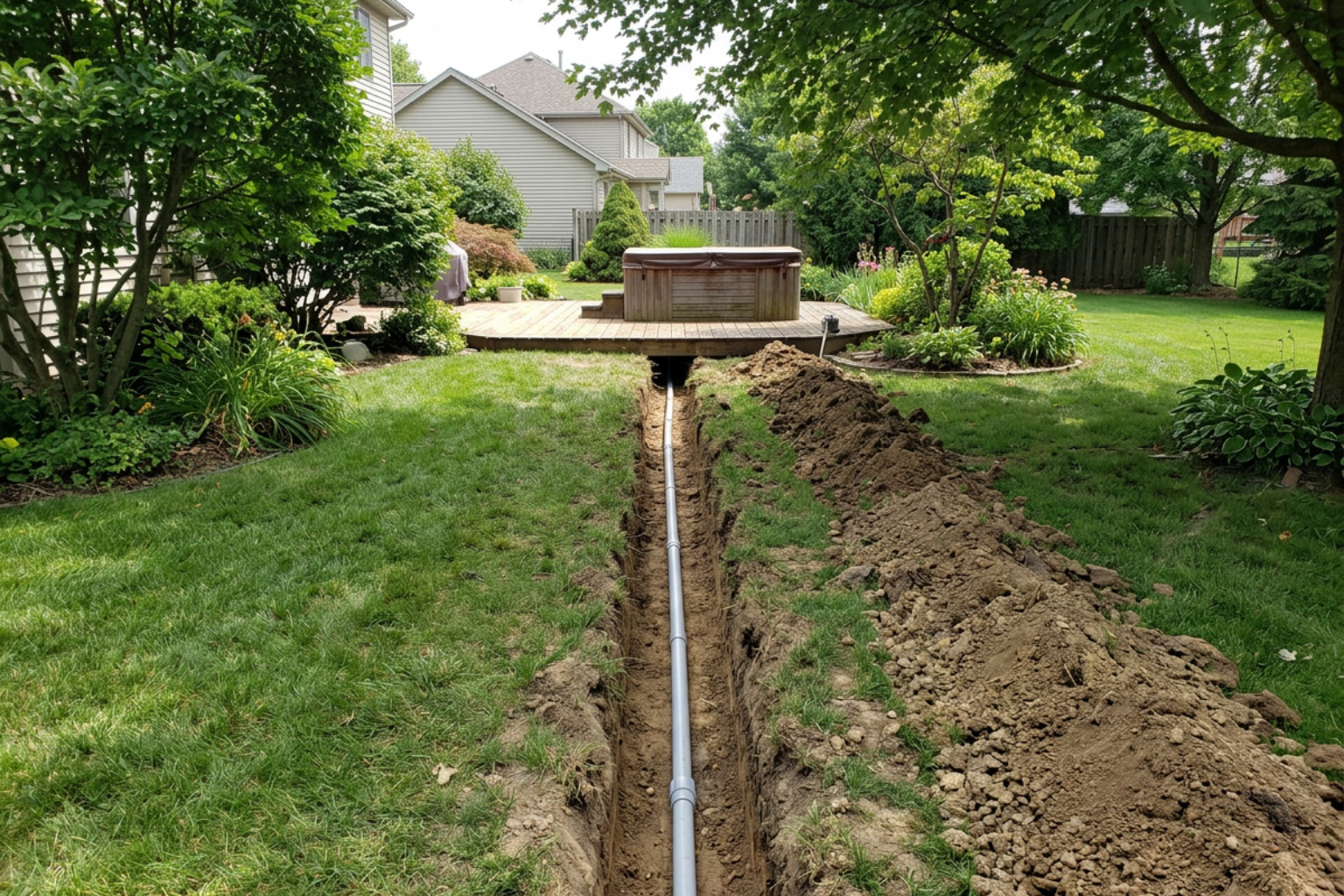
Trench burial depths depend entirely on the conduit material you choose:
- Schedule 40 or 80 Rigid PVC: Must be buried at least 18 inches deep from the top of the pipe to finished grade.
- Rigid Metal Conduit (RMC): Allowed at a minimum depth of 6 inches, though it is heavier and harder to work with.
- Liquidtight Flexible Conduit (LFNC): Permitted for the final exposed connection from your disconnect to the spa cabinet (usually limited to 6 feet).
In Colorado, we also install expansion joints on outdoor vertical PVC runs to prevent seasonal ground movement from pulling the conduit apart.
3-Wire vs 4-Wire Systems: How to Wire Your Spa Properly
When opening up the spa control box, you will typically find either a 3-wire or a 4-wire terminal block.
Knowing the difference prevents wiring errors that can damage sensitive control boards.
4-Wire vs 3-Wire 50 Amp Hot Tub Wiring Diagram Connections
Almost every modern spa built in the last twenty-five years uses a 4-wire configuration.
A 4-wire system includes two 120V hot lines (Line 1 and Line 2), one shared neutral wire, and one insulated equipment ground wire.
The two hots provide 240 volts for the main heater and jet pumps. The white neutral wire allows the spa to tap 120 volts for auxiliary components like digital control panels, LED mood lighting, audio systems, and ozonators.
Older or purely mechanical tubs sometimes use a 3-wire setup (two hots and a ground, without a neutral).
If you are working on an older unit, our guide on Hot Tub Wiring Simplified: Your 3-Wire GFCI Guide explains how those legacy connections work.
Wiring the 50A GFCI Breaker and Preventing Neutral Tripping
Miswiring the neutral conductor is the number one reason a newly installed hot tub breaker trips instantly.
A 50-amp GFCI breaker monitors the balance of electrical current between the hot legs and the neutral. If it detects a leakage current as small as 5 milliamps, it cuts the circuit in milliseconds.
We cover proper panel setups in our guide to Sub-Panel Power: Wiring Your Hot Tub GFCI Safely.
To wire the disconnect subpanel properly:
- Bring the incoming white neutral from the main house panel and attach it directly to the neutral bus bar in the disconnect box.
- Uncoil the breaker’s built-in white curly pigtail wire and screw it securely into the neutral bus bar.
- Take the outgoing white neutral wire that goes to the hot tub and land it directly on the terminal marked “LOAD NEUTRAL” on the GFCI breaker itself.
- Land the two outgoing hot wires on the breaker’s load lugs and the green ground wire on the equipment grounding bar.
A classic mistake is connecting the hot tub’s load neutral directly to the neutral bus bar rather than to the breaker.
This error bypasses the internal sensing coil, causing the breaker to trip immediately when powered on.
Reviewing common DIY Hot Tub Wiring Mistakes can save hours of head-scratching.
Meeting strict NEC spa GFCI standards keeps everyone in the water safe.
NEC Safety Rules: Disconnect Placement, Receptacles, and Bonding
National safety standards for pools and spas exist to prevent accidental contact with electricity in wet areas.
Line-of-Sight Disconnect Box Clearance
The emergency disconnect switch (or spa panel) allows anyone to kill power quickly if someone is in trouble.
According to the electrical code, this disconnect must meet specific placement rules:
- Minimum Distance: It must be installed at least 5 feet away from the inside water edge of the spa. This keeps bathers from reaching out and touching the electrical box while sitting in the water.
- Maximum Distance & Visibility: It must be located within 50 feet of the tub and remain clearly visible (in the direct line of sight) without walking around corners or through doorways.
For more details on these spatial rules, see our breakdown of the Hot Tub Electrical Code GFCI.
The electrical code also requires at least one standard 120V GFCI convenience outlet located between 6 and 20 feet from the hot tub.
This dedicated outlet keeps people from running dangerous extension cords near the water to power patio lights or phone chargers.
What to Ask Your Electrician Before Your Colorado Custom Spa Arrives
Buying a luxury spa is an exciting upgrade for any home.
As the authorized installation partner for Colorado Custom Spas, we work closely with homeowners across Denver, Castle Rock, and Parker to prepare their backyards before delivery day.
Getting your wiring ready ahead of time prevents delivery delays and protects your spa’s warranty.
Here are five key questions to ask your electrician before delivery day:
- “Does my installation meet the manufacturer’s exact high-voltage specifications?” Hot tubs require precise voltage delivery. An authorized installation partner ensures your pump and heater warranties remain fully intact.
- “Will you handle the municipal electrical permit and schedule the final city inspection?” Outdoor 240V circuits require local building permits in Colorado cities like Centennial, Lone Tree, and Highlands Ranch.
- “Is the subpanel disconnect placed in direct line of sight but at least 5 feet from the water?” Ensuring this spacing prevents failed inspections.
- “How will you route the underground conduit across my landscaping or patio?” Knowing the path helps you prepare the site, protect grass, or sleeve conduit before a concrete pour.
- “Do you include an equipotential bonding grid connection if required by the spa model?” Bonding ties external metal parts together to eliminate voltage differences around the patio.
Planning these details in advance makes delivery smooth, quick, and stress-free.
Frequently Asked Questions About 50 Amp Hot Tub Wiring
Can I use 8 gauge wire for a 50 amp hot tub?
In almost all residential hot tub setups, 8 gauge wire is not suitable.
While 8 AWG copper with 90°C insulation has an ampacity rating of 50 amps on paper, circuit breaker lugs and equipment terminals are almost always rated for 75°C.
Under the 75°C column of electrical code tables, 8 AWG copper is only rated for 40 amps.
Because hot tubs are heavy continuous loads, 6 AWG copper conductor is the standard requirement. It safely carries up to 55–65 amps without overheating.
Why does my new hot tub GFCI breaker trip immediately?
If a brand-new breaker trips the instant you turn it on (even before turning on pumps or heat), the problem is usually a miswired neutral.
In most cases, the white load wire going to the hot tub was landed on the disconnect panel’s neutral bus bar instead of directly onto the GFCI breaker’s load neutral terminal.
Other common causes include a pinched wire inside the conduit, moisture in the subpanel, or an improper shared neutral connection with another household circuit.
How far does the emergency disconnect switch need to be from the hot tub?
The disconnect box must be mounted at least 5 feet away from the water’s edge to keep bathers from touching the switch while inside the spa.
At the same time, it cannot be farther than 50 feet away, and it must be in clear line of sight from the tub without any walls, trees, or structures blocking the view.
Conclusion
What I usually see in Denver homes is that getting a hot tub wired properly comes down to simple preparation and clean workmanship.
Skipping steps on wire sizing, rushing conduit depths, or mixing up neutral connections can turn an exciting delivery day into a frustrating afternoon of tripped breakers.
When you invest in a quality hot tub, you want the peace of mind that comes from knowing the electrical work was done right the first time.
At Harmony Electric, we take pride in clean, straightforward installations that meet high standards and keep your backyard safe.
If you’re getting ready to install a new spa in Denver, Castle Pines, Parker, or the surrounding metro area, our team is here to help.
Explore our professional hot tub installation services to get your project on the schedule and backed by our lifetime workmanship guarantee.