Why 3-Wire Hot Tub Wiring Confuses Even Licensed Electricians
3 wire hot tub gfci setups use only two hot wires and a ground—no neutral—which means you need to wire the GFCI disconnect differently than most people expect.
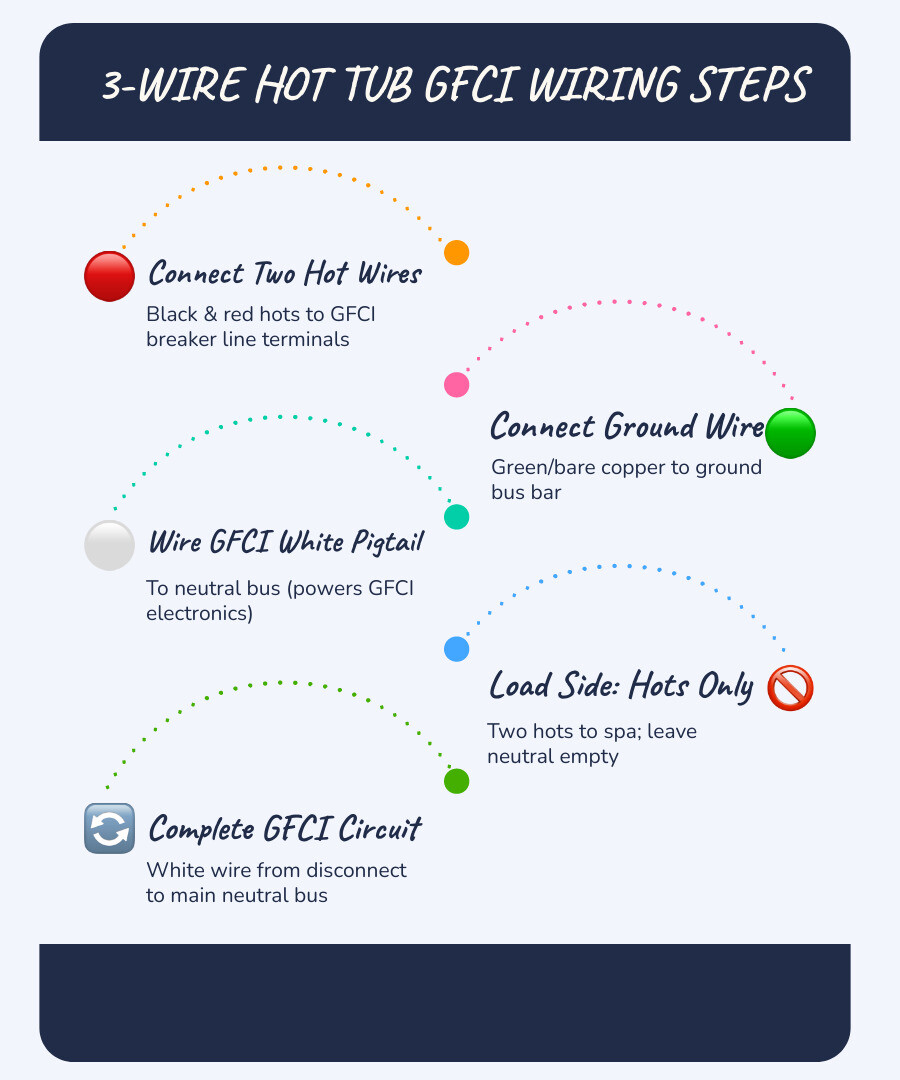
Quick Answer for 3-Wire Hot Tub GFCI Wiring:
- Connect two hot wires (black and red) to the GFCI breaker terminals
- Connect ground wire (green or bare copper) to the ground bus
- Connect the GFCI’s white pigtail to the neutral bus in your disconnect panel (this powers the GFCI electronics)
- Leave the load neutral terminal empty on the GFCI—your 3-wire hot tub doesn’t need it
- Run a white wire from the disconnect back to your main panel’s neutral bus to complete the circuit for the GFCI itself
I’ve seen this scenario dozens of times in Denver homes: a homeowner buys a Sundance or Jacuzzi spa that only needs 240V power, and their electrician tries to wire it like a 4-wire system. The result? Either the GFCI trips immediately, or they call me confused about where that white pigtail goes.
Here’s what most people don’t realize: your hot tub doesn’t need a neutral wire, but your GFCI breaker does. The GFCI’s internal electronics need 120V to monitor the circuit and trip when there’s a ground fault. That’s why you’ll see a white wire running to the disconnect even though nothing on the load side connects to it.
The research shows that many manufacturers—including popular brands like Sundance and Jacuzzi—still use 3-wire configurations because their heaters run on pure 240V and they don’t include 120V accessories like stereos or fancy lighting. If you bought your spa in the last few years and it only has terminals for two hots and a ground, you’ve got a 3-wire system.
This guide will walk you through exactly how to wire a 3-wire hot tub to a GFCI disconnect, where that mysterious white pigtail connects, and how to avoid the mistakes that cause nuisance tripping or failed inspections.
3 wire hot tub gfci terms at a glance:
3-Wire vs. 4-Wire: What’s the Difference?
When we talk about “wires” in hot tubs, we are usually referring to the current-carrying conductors and the safety ground. In a standard 4-wire setup, you have two “hot” wires (carrying 120V each), one neutral wire, and one ground wire. This allows the tub to run 240V components like the heater while also powering 120V components like a digital control panel, ozonator, or LED lights by using one hot and the neutral.
However, many high-end spas, particularly from brands like Sundance and Jacuzzi, utilize a 3-wire setup. This consists of two hots and a ground—period. There is no neutral wire required at the tub itself.
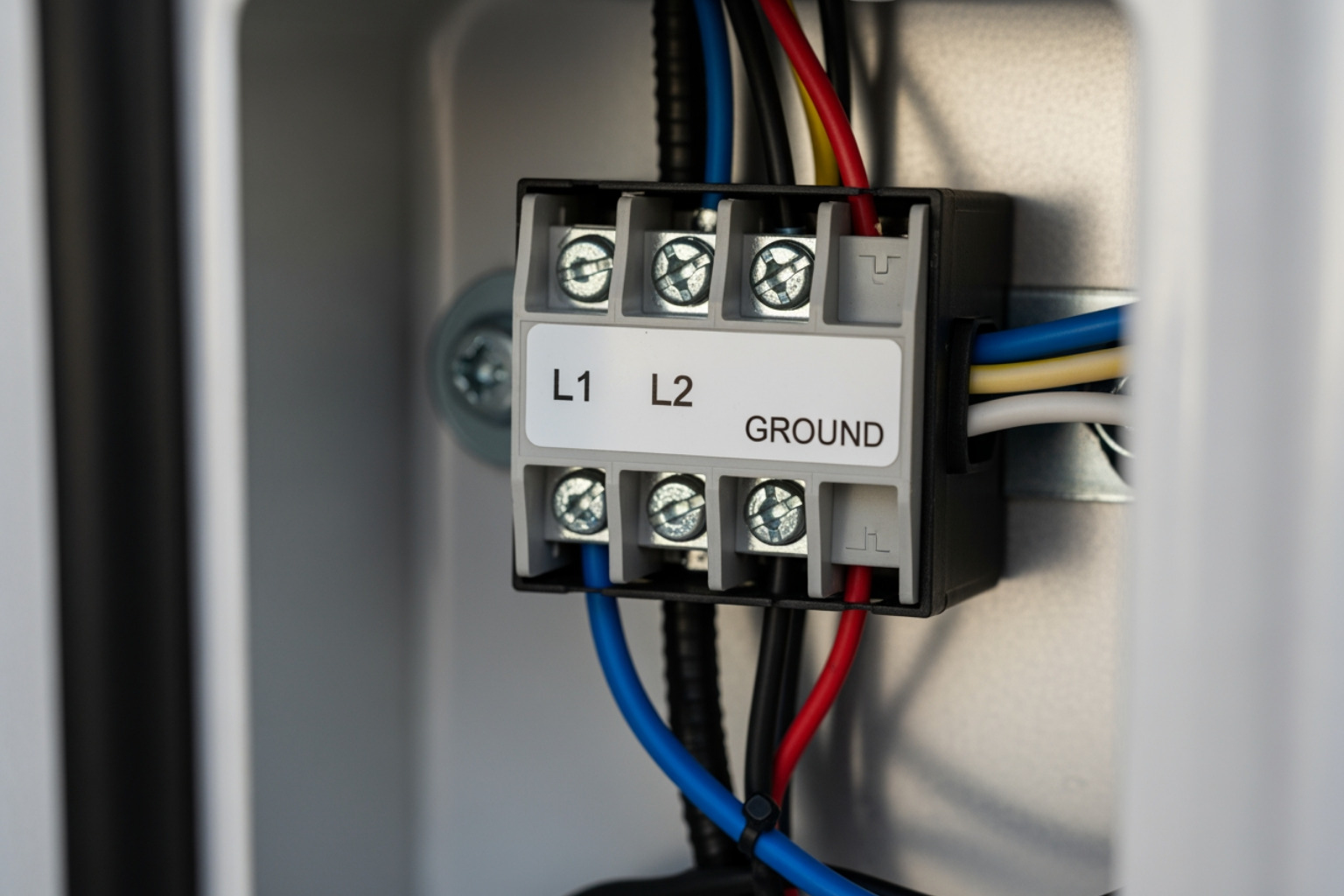
Why would a manufacturer do this? It’s often about efficiency and simplicity. If the entire control system and all the pumps are designed to run on 240V, there is no need for a neutral return path from the spa. The heater is a pure 240V load, and the pumps are often 240V as well.
If you aren’t sure what you have, check our Hot Tub Amperage Guide or look at the terminal block inside your spa’s control pack. If you only see three lugs (labeled L1, L2, and Ground), you are looking at a 3-wire system.
It is important to note that you should never try to “convert” a 4-wire tub to a 3-wire service. If the tub’s manufacturer requires a neutral, that neutral must be present to prevent damaging the electronics or creating a fire hazard. But for a dedicated 3-wire tub, adding a neutral is unnecessary and can actually cause your 3 wire hot tub gfci to trip if it isn’t handled correctly at the disconnect.
Can You Safely Use a 3 Wire Hot Tub GFCI?
One of the most common questions I get in the Denver Metro area is: “If there’s no neutral wire, how can a GFCI even work?”
It’s a great question. Most people think a Ground Fault Circuit Interrupter (GFCI) only looks for power leaking to the ground. In reality, a GFCI breaker is a tiny computer that constantly compares the amount of current going out on the hot wires to the amount of current coming back. In a 3-wire system, it monitors the balance between the two 120V legs (the two hots). If even a tiny amount of current (as little as 5mA) goes missing—meaning it’s likely “leaking” through a person or into the water—the breaker snaps off instantly.
According to NEC 680.44, GFCI protection is mandatory for all hot tubs and spas. This isn’t just a suggestion; it’s the law, and for good reason. Water and electricity are a dangerous mix. The GFCI protection standards ensure that if a heater element cracks or a pump motor seals fail, the power cuts before anyone gets hurt.
We take these Hot Tub Electrical Code GFCI requirements very seriously at Harmony Electric. Whether you are in Castle Rock or Highlands Ranch, the physics of electricity doesn’t change. A 3 wire hot tub gfci is perfectly safe and code-compliant, provided the breaker is wired to “see” the circuit correctly.
How to Wire a 3-Wire Spa to a GFCI Disconnect
Wiring a spa disconnect is where most DIY projects go sideways. The “disconnect” is that small gray box (often called a spa pack or subpanel) mounted on the wall of your house, usually between 5 and 50 feet from the tub.
For a 50A or 60A circuit, we typically use #6 THHN copper wire. I always recommend copper over aluminum for hot tubs. Aluminum expands and contracts more than copper, which can lead to loose connections in a high-vibration environment like a spa.
When you are Hooking Up 220V Hot Tub equipment, the process involves pulling these heavy wires through conduit from your main house panel to this disconnect box. Once the wires are there, you have to be very specific about where they land on the GFCI breaker.
Connecting the 3 wire hot tub gfci pigtail
Every 2-pole GFCI breaker comes with a factory-installed white “pigtail” wire. This is the part that trips people up (pun intended).
In a 3 wire hot tub gfci installation, here is the rule:
- The white pigtail from the breaker must connect to the neutral bus bar in the disconnect box.
- A white neutral wire must run from that same neutral bus bar back to the neutral bus in your main electrical panel.
- Crucial Step: Do NOT connect this pigtail to the ground bar.
Even though your hot tub doesn’t use a neutral, the breaker itself needs that neutral connection to power its own internal sensing logic. If you don’t connect the pigtail to a neutral return path to the main panel, the “test” button won’t work, and the breaker may not provide the protection you’re paying for. You can see a clear Wiring diagram for 3-wire GFCI that illustrates this path.
Handling the load side of a 3 wire hot tub gfci
Now, let’s look at the “load side”—the wires going from the disconnect box out to the hot tub.
Since this is a 3-wire spa, you will only have three wires leaving the disconnect:
- Hot 1 (Black): Connects to the load terminal on the GFCI breaker.
- Hot 2 (Red): Connects to the other load terminal on the GFCI breaker.
- Ground (Green/Bare): Connects to the ground bus bar in the disconnect box.
The “Load Neutral” terminal on the GFCI breaker (the silver screw on the breaker itself) will remain empty. This is perfectly normal for a 3-wire setup. Because there is no neutral wire coming from the tub, there is nothing to land on that terminal. The breaker will still monitor the two hot wires and trip if it detects an imbalance.
Avoiding Common Wiring Mistakes
I’ve spent a lot of my career in Denver and Parker fixing DIY Hot Tub Wiring Mistakes. Some of these are minor inconveniences, but others are genuinely dangerous.
1. The Neutral-Ground Bond One of the biggest mistakes is bonding the neutral and ground bars in the spa disconnect. In your main service panel, neutral and ground are often connected. However, in any subpanel or disconnect, they must be kept separate. If you connect them at the spa box, you create a “parallel path” for electricity, which can lead to your metal spa components becoming energized.
2. Nuisance Tripping If your 3 wire hot tub gfci trips the second you turn it on, check your neutral pigtail. If the pigtail is connected to the ground bar instead of the neutral bar, or if you’ve accidentally landed the tub’s ground wire on the breaker’s neutral terminal, it will trip every time.
3. Splicing Rules Sometimes the white wire from the main panel is just a few inches too short to reach the neutral bus in the disconnect. I often get asked if it’s okay to splice it. The answer is yes—per the NEC, you can splice wires in the panel or disconnect using a properly sized wire nut. Just make sure the connection is tight; loose neutrals are a leading cause of electrical fires.
4. Using the Wrong Breaker Not all GFCI breakers are created equal. Some older or cheaper “earth leakage” breakers aren’t designed for US 240V systems. Always use a UL-listed breaker that matches your panel brand (e.g., Square D, Siemens, or Eaton). Specifically, the Square D QO260GFI is a popular 60A choice designed for these applications.
Location and Conduit Requirements
The electrical code isn’t just about how you move the wires; it’s about where you put them. When we install an Electrical Box for Hot Tub use in Centennial or Highlands Ranch, we have to follow strict placement rules:
- Line of Sight: The disconnect must be within sight of the hot tub. This is so a service technician can see that the power is off while they are working on the pumps.
- Distance: It must be at least 5 feet away from the water’s edge (to prevent someone in the tub from touching it) but generally no further than 50 feet.
- Burial Depth: If we are running PVC conduit under your lawn, it must be buried at least 18 inches deep. If you’re using rigid metal conduit, you can go as shallow as 6 inches, but in the rocky soil we have around Castle Pines, 18 inches in PVC is usually the standard.
- Expansion Joints: Here in Colorado, the ground freezes and thaws. This “heaving” can snap PVC conduit like a toothpick. We always install expansion joints on the vertical runs of conduit to allow the pipe to move without pulling the wires out of the terminals.
Frequently Asked Questions about 3-Wire Spas
Why is my GFCI tripping immediately on a 3-wire setup?
The most common reason is a “neutral-to-ground” fault. This usually happens when the white pigtail from the GFCI is mistakenly connected to the ground bus instead of the neutral bus. Another culprit is a moisture leak inside the spa’s heater element. Even if the tub is brand new, a tiny hairline crack in the heater can leak enough current into the water to trip a sensitive 3 wire hot tub gfci.
What wire size do I need for a 50A or 60A hot tub?
For a 50A circuit, we use #6 THHN copper. While code technically allows #8 for 50A in some specific conditions, the long runs we often see in Denver homes mean that #6 is the safer, more reliable choice to prevent voltage drop. For a 60A circuit, #6 THHN is mandatory. Always use stranded wire; it’s much easier to pull through conduit than solid wire.
Can I add a 120V outlet to my spa disconnect panel?
Yes, but only if the disconnect box you purchased has extra “spaces” or “circuits” available. Many spa panels (like the Siemens 60A spa pack) have room for two additional 120V breakers. This is a great way to add the code-required “convenience outlet” that must be located between 6 and 20 feet from the spa. Just remember that the feeder wires from your main house panel must be sized to handle the total load of both the spa and the outlet.
Conclusion
Wiring a 3 wire hot tub gfci might seem straightforward, but as we’ve discussed, the details matter. From ensuring that neutral pigtail finds its way to the right bus bar to choosing the right copper wire gauge, every step is a matter of safety and reliability.
At Harmony Electric, we pride ourselves on doing the job right the first time. We know the local codes in Denver, Castle Rock, and the surrounding areas inside and out. We don’t believe in unnecessary complexity or upselling—just clean, high-quality electrical work that lets you enjoy your spa without worry.
Whether you’ve just bought a new Sundance spa or you’re troubleshooting an old Jacuzzi, we’re here to help. We even back our Hot Tub Installation Services with a lifetime workmanship guarantee.
If you’re ready to get your hot tub up and running safely, give us a call. We’ll make sure your wiring is as relaxing as the water you’re about to soak in.
Randy Harmuth Master Electrician & Owner, Harmony Electric