What You Need to Know About 16 Amp Hot Tub Wiring Before You Touch a Wire
16 amp hot tub wiring is one of those topics that seems simple on the surface — until you realize there’s a lot more going on behind the scenes than just plugging something in.
Here’s the quick answer most homeowners are looking for:
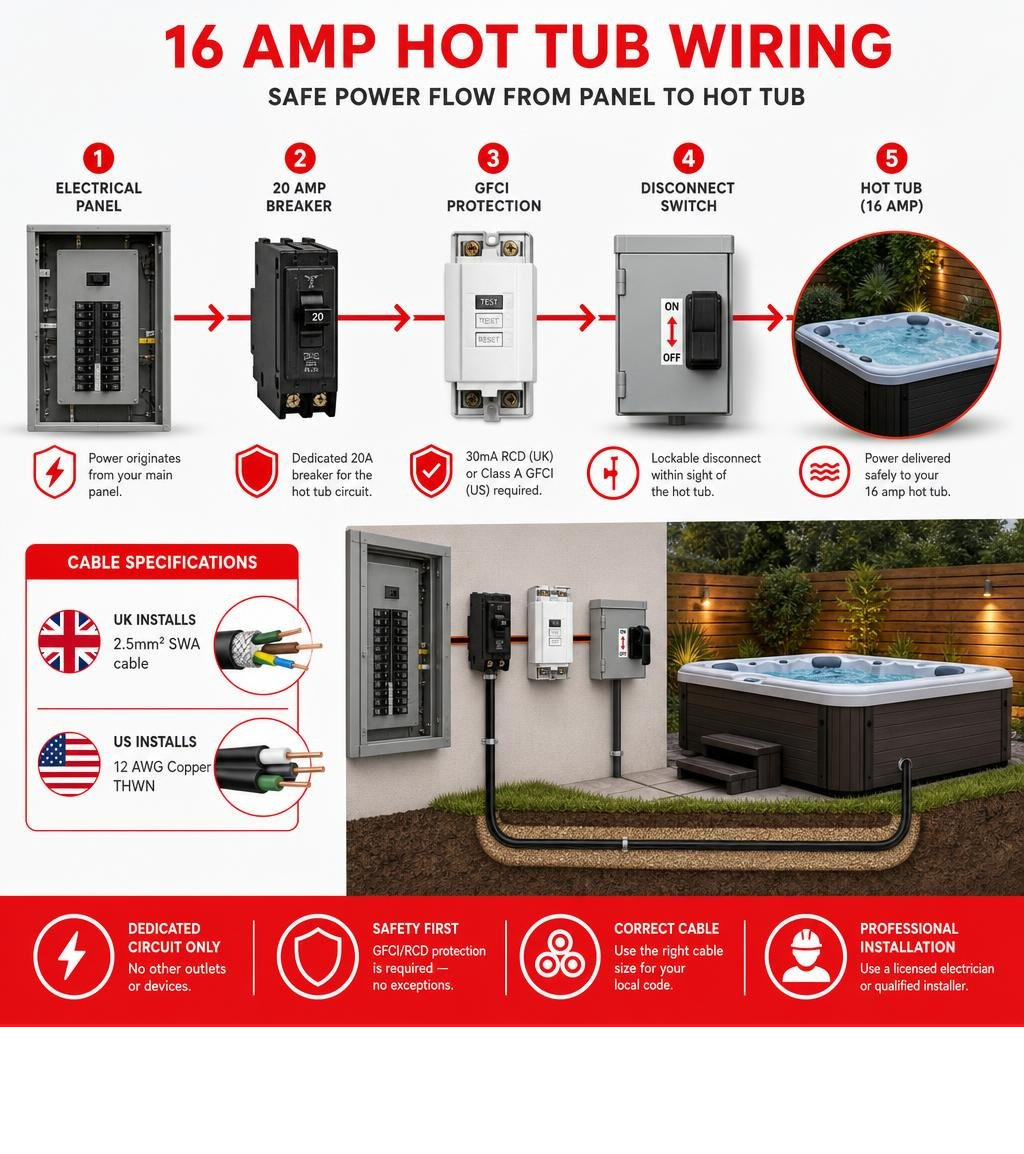
A 16 amp hot tub requires a dedicated circuit — not a standard household outlet. Here’s what that means in practice:
- Dedicated circuit: The hot tub needs its own breaker in your main panel, shared with nothing else
- Breaker size: A 20-amp breaker is typically used (continuous loads require a 25% buffer above the draw)
- Cable: 2.5mm² SWA cable for UK installs; 12 AWG copper THWN for US installs
- RCD/GFCI protection: A 30mA RCD (UK) or Class A GFCI breaker (US) is required — no exceptions
- Who can do it: A licensed electrician; in the UK, a Part P registered installer
Most homeowners are surprised to learn that a 13-amp plug on the ring main — which is how some people run these tubs — is not safe, not code-compliant, and can cause real damage over time.
I’ve seen melted outlets and scorched wiring from exactly that setup. It’s a common shortcut that just isn’t worth the risk.
This guide walks you through everything: what the 16-amp rating actually means, how to wire it correctly, what size cable and breaker you need, and how it compares to 13-amp and 32-amp hot tubs.
16 amp hot tub wiring terminology:
Demystifying the 16-Amp Hot Tub Rating
When you buy a hot tub rated for 16 amps, that number tells us the maximum current the spa will draw when everything is running at the same time. This includes the heater, the jet pumps on high speed, the filtration pump, the lighting, and any auxiliary systems like UV sanitizers or ozonators.
In the electrical world, we have to look at how these components interact. A hot tub is considered a continuous load because it can run for hours at a time. Because of this, we cannot design a circuit that runs at exactly 16 amps of capacity.
Most 16-amp spas are designed with an internal controller that manages the power. On a 16-amp limit, the control board might allow the heater to run on low power while the jets are on, or it might turn the heater off entirely when you activate the high-speed massage jets.
Understanding how your specific tub handles this power balance is key to planning your installation. For a deeper dive into how different hot tubs draw power, check out our hot tub amperage guide.
The Danger of the 13-Amp Plug Shortcut
In some regions, particularly the UK, homeowners are tempted to use a standard 13-amp plug and a household ring main to power their 16-amp rated hot tubs. It is a common shortcut because it avoids the immediate cost of running a new circuit.
However, running a continuous 16-amp load through a standard 13-amp household socket is a significant fire hazard. Standard household outlets and plugs are designed for intermittent loads, not continuous high-draw operation.
Over hours of continuous operation, the pins on a standard plug will get hot. This heat transfers to the socket, which can degrade the plastic, melt the casing, and eventually cause an electrical fire.
Even if the fuse in the plug doesn’t blow immediately, the constant thermal stress damages your home’s wiring. If you are drawing more power than the outlet is rated to handle, you are compromising the safety of your entire household.
Planning Your 16 Amp Hot Tub Wiring Project
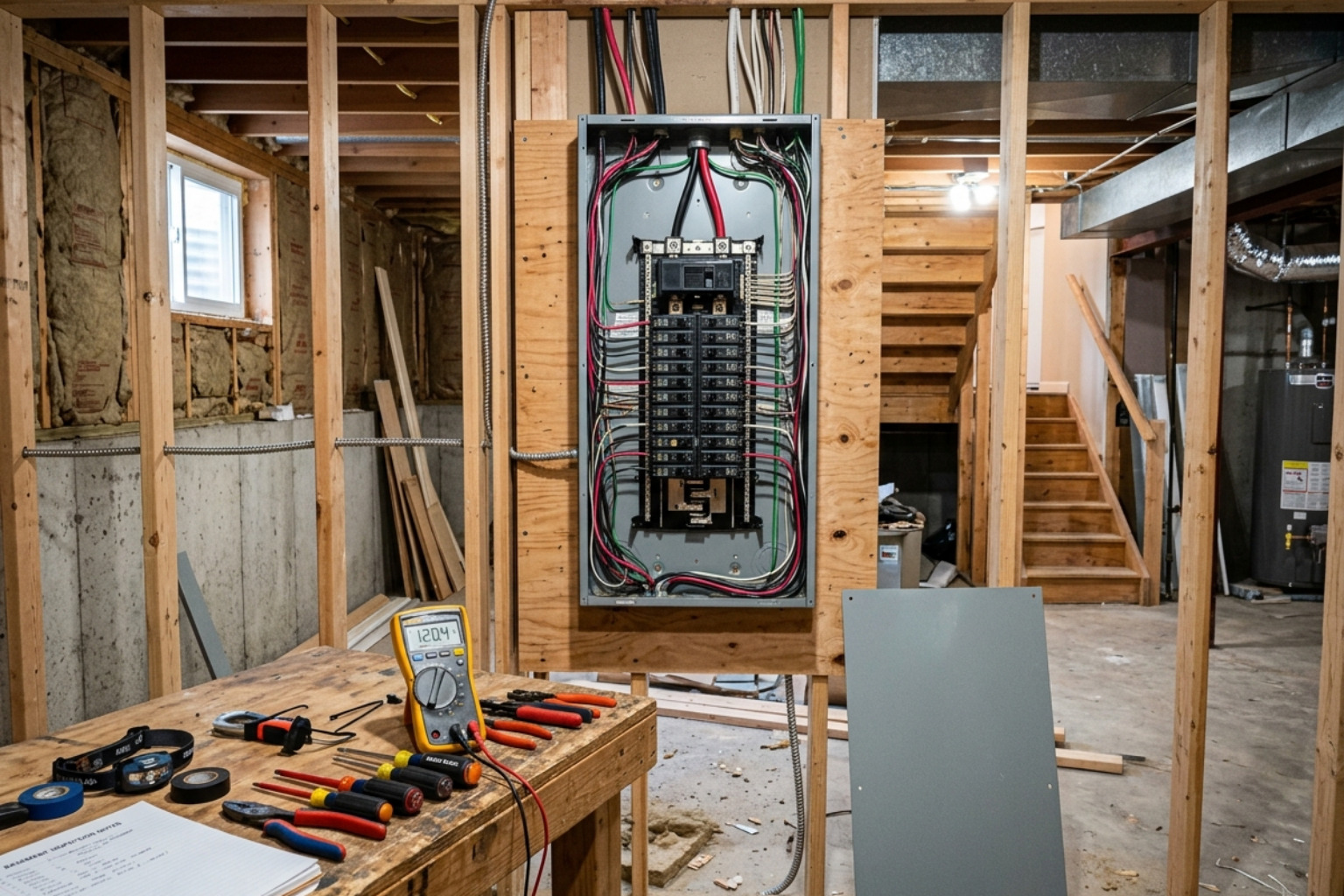
Before you buy any materials or dig any trenches, you need a solid plan. A proper hot tub installation requires a dedicated radial circuit running directly from your home’s main electrical service panel to an outdoor disconnect switch, and then to the spa itself.
First, you must assess your existing electrical panel to ensure it has the physical space and the load capacity to handle the new addition. If your home has an older 100-amp service, we need to calculate your current household electrical demand to make sure you won’t overload the main breaker when the hot tub is running alongside your AC or dryer.
Next, map out the conduit route. The electrical run should go from your panel, through your basement or crawlspace, and exit the home to run underground or along a structural wall to the hot tub area. Keeping the run as short and straight as possible helps minimize voltage drop and lowers your material costs.
Cable and Breaker Sizing for 16 Amp Hot Tub Wiring
For a 16-amp continuous load, electrical codes require us to apply a 125% safety margin when sizing the circuit breaker and the supply conductors.
This means you must use a dedicated 20-amp circuit breaker.
For the wiring, we recommend using high-quality copper conductors. Aluminum wire is not suitable for hot tub connections because it expands and contracts more than copper, which can lead to loose terminals and corrosion in wet environments.
For US installations, you should run individual THHN/THWN copper conductors inside an approved PVC conduit. We use 12 AWG copper wire for a standard 20-amp run. If your hot tub is located more than 100 feet from your main panel, you should upsize the wire to 10 AWG to prevent voltage drop from affecting the spa’s performance.
For a detailed look at selecting the right wire types for outdoor 220V setups, read our 220V wire breakdown.
Common Mistakes in 16 Amp Hot Tub Wiring
Over my years of working in Denver, Castle Rock, and Highlands Ranch, I have seen plenty of DIY attempts gone wrong. Here are the most common mistakes to avoid:
- Sharing the circuit: Connecting patio lights, outdoor speakers, or water pumps to the same circuit as your hot tub. A hot tub must always have its own dedicated breaker.
- Using standard Romex outdoors: Standard indoor Romex (NM-B) wire is not rated for wet locations. Even inside a conduit, moisture will eventually get in and degrade the insulation.
- Skipping the GFCI/RCD: Some people bypass the safety breaker to save money. Water and electricity are a lethal mix; you must have Class A GFCI or 30mA RCD protection.
- Incorrect burial depth: Running conduit just a few inches below the grass. If you are trenching through your yard, PVC conduit must be buried at least 18 inches deep to protect it from lawnmowers and shovels.
Comparing 16-Amp Spas to 13-Amp and 32-Amp Models
When choosing a hot tub, understanding how the amperage affects your daily use is incredibly important. The power capacity directly dictates how fast your tub heats up and whether you can run the heater and the jet pumps at the same time.
- 13-Amp Models (Plug-and-Play): These are simple to set up but highly limited. They usually have a smaller 2kW heater and a single pump. When you turn the jets on high, the system automatically turns the heater off to avoid tripping the plug’s fuse. This means your water temperature will start dropping during winter use.
- 16-Amp Models: These offer a great middle-ground. They are hardwired on a dedicated line, which allows for a slightly larger heater (usually 3kW) and better jet performance. While some models still cycle the heater off when multiple pumps run on high, they heat up much faster than 13-amp plug-and-play units.
- 32-Amp Models: These are the gold standard for luxury spas. With a dedicated 32-amp (or 50-amp in the US) supply, you can run a powerful 4kW or 5.5kW heater alongside multiple high-speed therapy pumps and blowers simultaneously. The water stays hot no matter how long you soak or how cold the Colorado winter gets.
| Feature | 13-Amp Spa | 16-Amp Spa | 32-Amp / 50-Amp Spa |
|---|---|---|---|
| Connection Type | Standard Plug-and-Play | Hardwired Dedicated Line | Hardwired Dedicated Line |
| Heater Size | 1.5kW – 2kW | 2kW – 3kW | 3kW – 5.5kW |
| Simultaneous Run | No (Heater shuts off when jets are on high) | Limited (Depends on control board settings) | Yes (Heater and all pumps run together) |
| Heating Speed | Very slow (1.5 – 2°F per hour) | Moderate (2 – 3°F per hour) | Fast (4 – 6°F per hour) |
| Electrical Prep Cost | Low (uses existing outlet if nearby) | Moderate (requires new circuit) | Higher (requires larger wire and subpanel) |
Professional Installation, Permits, and Safety Standards
Any outdoor electrical installation involving water must adhere strictly to local codes and safety standards. In the United States, this means following NEC Article 680, which outlines the rules for swimming pools, fountains, and hot tubs.
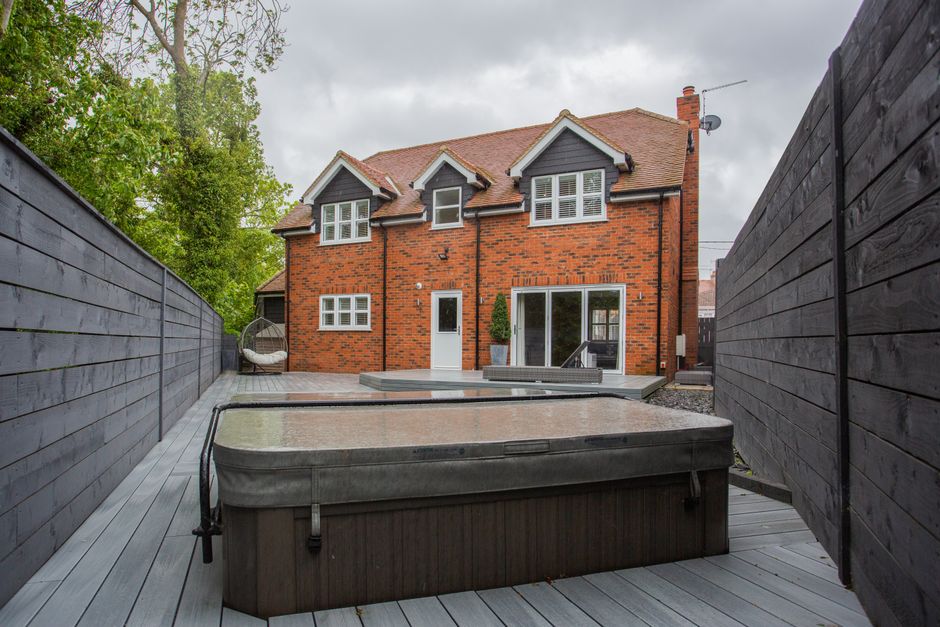
First, you must install a local maintenance disconnect switch (often called a spa pack or subpanel) within sight of the hot tub. This switch must be located at least 5 feet from the water’s edge to prevent a bather from reaching it while wet, but no more than 50 feet away so an emergency shutoff is always close at hand.
Second, you must ensure proper equipotential bonding. This is one of the most overlooked safety requirements. It involves connecting all metal parts within 5 feet of the hot tub — including metal handrails, window frames, or deck brackets — to a common bonding grid using a solid 8 AWG copper wire. This eliminates any voltage differences between conductive surfaces, keeping you safe from accidental shocks.

While it’s tempting to handle the wiring yourself, most high-end manufacturers require professional certification to keep your protection active. As the authorized installation partner for Colorado Custom Spas, Harmony Electric ensures your unit is wired to exact factory specifications, protecting your investment from day one.
To learn more about the specific codes we follow in Colorado, check out our detailed GFCI breaker guide.
Frequently Asked Questions About Hot Tub Electrics
Can I run a 16-amp hot tub on a standard household outlet?
No. A standard household outlet in the US is rated for 15 amps (with a continuous draw limit of 12 amps). A 16-amp hot tub will immediately overload a standard outlet, tripping the breaker or causing the plug and receptacle to overheat. You must install a dedicated 20-amp circuit.
What size breaker do I need for a 16-amp hot tub?
You need a dedicated 20-amp double-pole breaker. Because hot tubs run continuously, electrical codes require a 25% safety buffer above the hot tub’s maximum draw, which brings the required breaker capacity to 20 amps.
Do I need a permit to wire a 16-amp hot tub in Denver?
Yes. Virtually all municipalities in the Denver metro area, including Parker, Centennial, and Lone Tree, require an electrical permit for hot tub installations. This ensures that a city inspector will review the trench depth, disconnect placement, and bonding to verify that the installation is safe.
Conclusion
Installing a hot tub is one of the best ways to upgrade your backyard and create a relaxing retreat right at home. However, cutting corners on the electrical work can turn your dream investment into a safety hazard or void your manufacturer’s warranty.
Doing the job right the first time is what we do best. At Harmony Electric, led by Master Electrician Randy Harmuth, we provide clean, high-quality, and code-compliant installations throughout the Denver Metro Area, Castle Rock, Highlands Ranch, and surrounding communities. All of our hot tub installations are backed by our lifetime workmanship guarantee and a three-year material warranty.
If you are ready to get your new spa wired safely and professionally, contact us today to learn more about our professional hot tub installation services.