Why a 30 Amp Hot Tub Disconnect Is More Important Than You Think
A 30 amp hot tub disconnect is a dedicated outdoor shutoff switch that cuts power to your spa quickly and safely — and the National Electrical Code requires one on every hot tub installation.
Quick answer: What is a 30 amp hot tub disconnect?
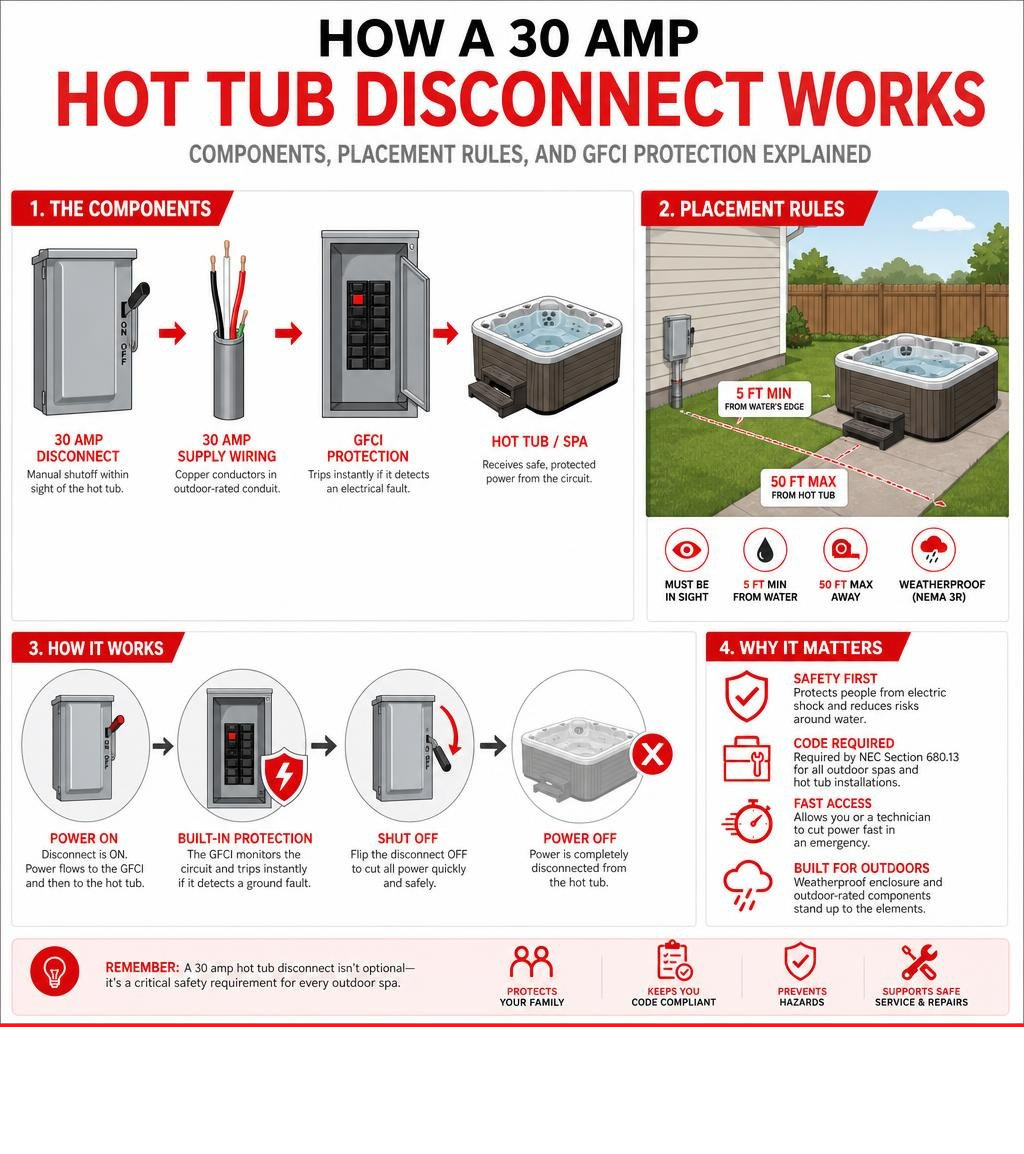
- It is a manual shutoff switch mounted outdoors, within sight of your hot tub
- It must be at least 5 feet from the water’s edge, but no more than 50 feet away
- It must be housed in a weatherproof (NEMA 3R) enclosure
- It allows you — or a technician — to cut power fast in an emergency
- It is required by NEC Section 680.13 for all outdoor spa and hot tub installations
Most homeowners are surprised to learn this isn’t optional. It’s not just a nice-to-have. It’s a safety requirement that protects the people using the tub and the technicians servicing it.
Here in Denver, I see the same scenario play out more than I’d like. Someone gets a beautiful new spa delivered, the excitement is real, and then they realize the wiring isn’t set up correctly. No disconnect. Wrong wire size. Or an outdoor run done with standard Romex that isn’t rated for wet locations.
Getting this right from the start isn’t complicated — but it does take knowing what the code requires and which components actually work together.
This guide walks you through everything: what type of disconnect you need, how to wire it correctly for a 30 amp circuit, what mistakes to avoid, and when it makes sense to call a licensed electrician.
Simple guide to 30 amp hot tub disconnect:
What is a 30 Amp Hot Tub Disconnect and Why is it Required?
When you install a hot tub, you are bringing high-voltage electricity and water into close contact. That combination requires serious safety measures.
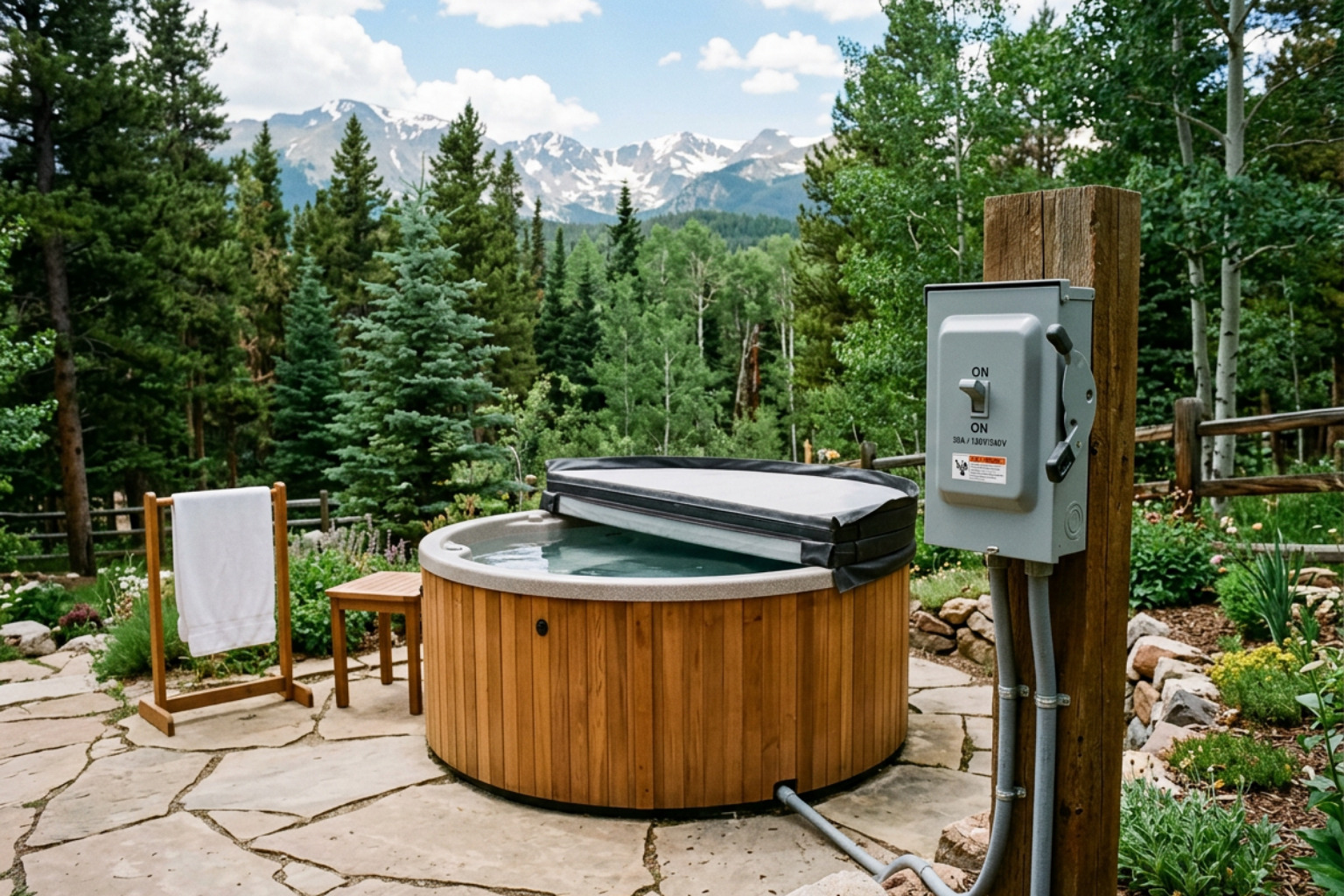
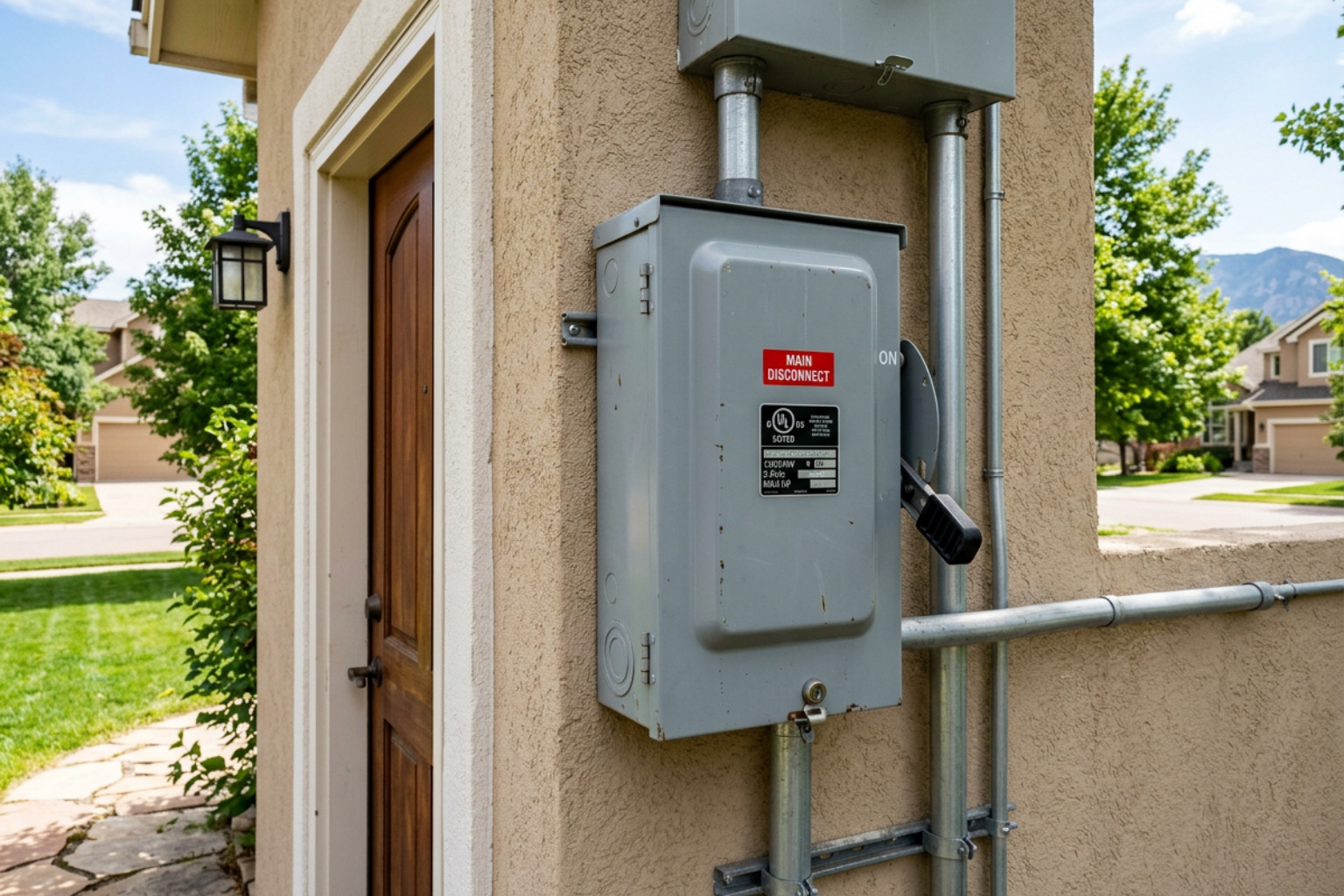
A 30 amp hot tub disconnect acts as a local safety bridge. It is an outdoor-rated switch box installed between your home’s main electrical panel and the hot tub itself. Its primary job is to give you a way to completely de-energize the tub without having to run down to a dark basement or around the side of the house to find the main breaker panel.
The National Electrical Code (NEC) is very clear about this in Section 680.13. Every outdoor spa or hot tub must have a maintenance disconnect. This rule exists for two very practical reasons:
- Emergency Situations: If someone is experiencing an electrical shock or there is a mechanical failure, every second counts. Anyone nearby needs to be able to walk over and flip a single switch to kill the power instantly.
- Safe Maintenance: When a technician comes out to service your heater, pump, or control board, they need to know the power is off. By using a local disconnect, they can see the switch is off, and some models even allow them to put a padlock on it so nobody accidentally flips the breaker back on inside the house while they are working.
To handle our Colorado winters, heavy snow, and summer storms, this switch must be housed in a NEMA 3R weatherproof enclosure. This rating ensures that rain, ice, and sleet cannot penetrate the metal box and reach the live electrical terminals inside.
If you want to dive deeper into how these safety standards protect your family, you can read our guide on hot tub electrical code gfci.
NEC Code Requirements for a 30 Amp Hot Tub Disconnect
When we install a 30 amp hot tub disconnect in areas like Centennial, Parker, or Highlands Ranch, we have to follow strict placement rules. Local building inspectors check these measurements down to the inch.
- The 5-Foot Minimum Rule: The disconnect box must be mounted at least 5 feet away from the inside wall of the hot tub. Why? Because we want to make absolutely sure you cannot sit in the water, reach out, and touch the physical metal switch box at the same time.
- The 50-Foot Maximum Rule: The switch cannot be more than 50 feet away from the tub. If it is too far, it defeats the purpose of being an emergency shutoff.
- The Line of Sight Rule: You must have a clear, unobstructed view of the disconnect box from the hot tub. If you have to walk around a privacy fence, go behind a brick pillar, or step around a corner to see the box, it fails inspection.
To learn more about how code compliance impacts your choice of hardware, consult local building codes and guidelines.
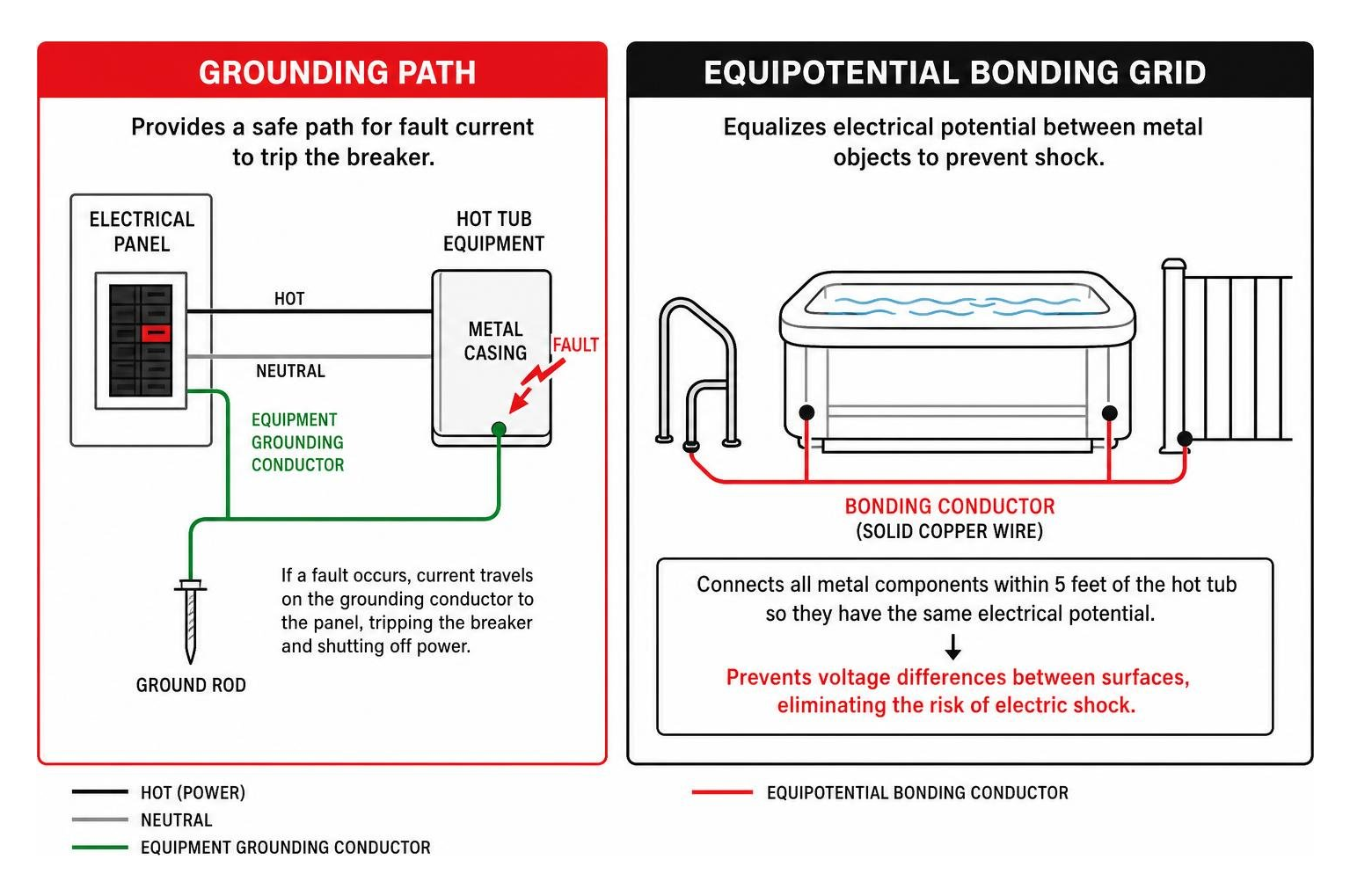
Grounding vs. Equipotential Bonding
I often talk to homeowners in Denver who get grounding and bonding confused. They sound like the same thing, but they perform completely different safety jobs in a wet environment.
Grounding is about creating a safe, low-resistance path for fault current to travel back to your main electrical panel. If a wire loose inside your hot tub heater touches the metal casing, the grounding wire carries that dangerous current away, instantly tripping the breaker instead of leaving the metal casing energized.
Equipotential bonding, on the other hand, is about equalizing the electrical pressure (voltage) around your hot tub. Water, wet concrete, metal handrails, and metal fences can all carry tiny amounts of electrical voltage. If you touch a metal railing while stepping out of the water, and those two surfaces have even a slight difference in voltage, you will get shocked.
Bonding connects all metal components within 5 feet of the hot tub together using a solid copper wire, creating a “bonding grid.” This ensures everything has the exact same electrical potential, eliminating the risk of a touch-voltage shock.
Choosing the Right Disconnect: Fused, Non-Fused, or GFCI Spa Panel?
When shopping for a disconnect, you will find three main options: fused pullouts, non-fused switches, and GFCI-protected spa panels. Choosing the right one depends on where your main overcurrent and ground-fault protection are located.
Here is a quick breakdown to help you compare your options:
| Disconnect Type | Built-In Overcurrent Protection? | Built-In GFCI Protection? | Best Use Case |
|---|---|---|---|
| Fused Pullout | Yes (Requires separate fuses) | No | When you need extra local overcurrent protection. |
| Non-Fused Switch | No | No | When the circuit is already protected by a GFCI breaker in the main panel. |
| GFCI Spa Panel | Yes (Built-in breaker) | Yes | The gold standard for outdoor hot tubs. |
If you want to understand how ground-fault protection keeps you safe, take a look at the shocking truth everything about hot tub gfci breakers.
Can I Use a Standard AC Disconnect for a 30 Amp Hot Tub?
Yes, you can use a standard air conditioning disconnect for a hot tub, but there is a major catch. We call this the GFCI Dependency Rule.
A standard, inexpensive AC disconnect — like a standard 30-Amp 120/240-Volt Fused AC Disconnect — does not have built-in GFCI protection. It is simply a physical switch or a pullout block.
If you use this type of disconnect, you must install a dedicated 30 amp GFCI circuit breaker inside your home’s main electrical panel. Without that upstream GFCI protection, a standard AC disconnect is a major safety hazard and will fail code inspection immediately.
Also, be aware of the “hidden fuse” pitfall with fused AC disconnects. Many DIYers install a fused disconnect box, hook up the wires, flip the switch, and get zero power. They assume the box is defective, but they actually just forgot to buy and install the physical fuses (usually sold separately) inside the pullout handle to complete the electrical bridge.
Sizing and Compatibility: 30 Amp vs. 50 Amp Setups
One of the most common questions I get on forums and service calls is: “Can I feed a 50 amp GFCI spa disconnect using a 30 amp breaker from my main panel?”
The short answer is yes. It is completely safe and code-compliant to use a larger disconnect enclosure (like a 50 amp or 60 amp rated panel) on a smaller 30 amp circuit.
The safety of your electrical wire depends entirely on the breaker inside your main panel. If you use 10 AWG copper wire (which is rated for 30 amps) and protect it with a 30 amp breaker at the main panel, the wire is safe. The 50 amp GFCI disconnect down the line simply acts as your safety switch and ground-fault protector.
For more details on matching your wire size to your breaker capacity, read our comprehensive hot tub amperage guide.
Wiring Specifications: Wire Size, Conduit, and Split-Load Circuits
Wiring an outdoor hot tub is very different from wiring a bedroom outlet. Because the wires run outdoors and underground, they are constantly exposed to moisture, soil movement, and temperature shifts.
Here are the strict rules we follow for a 30 amp hot tub circuit:
- No Romex (NM-B) Outdoors: Standard Romex cable is only rated for dry, indoor locations. You cannot run it inside a conduit outdoors, because moisture naturally condenses inside outdoor conduit over time. If Romex sits in that moisture, the outer jacket degrades, leading to short circuits.
- Use THWN Copper Wire: You must use individual THWN (or THHN/THWN-2) copper conductors pulled through a weatherproof conduit. For a 30 amp circuit, you need 10 AWG copper wire.
- Conduit Requirements: Use Schedule 40 PVC conduit for underground runs (buried at least 18 inches deep) and transitioning up the side of the house. You can use a short run of liquid-tight flexible metal or nonmetallic conduit (up to 6 feet) to connect the disconnect box directly to the hot tub’s control pack.
To see how these wires connect inside the panel, refer to our hot tub wiring simplified your 3 wire gfci guide.
The 30/20 Amp Split-Load Configuration
If you bought a premium spa from a brand like Hot Spring or Caldera, you might open the installation manual and find a surprise. Instead of a single 240V circuit, these tubs often require a unique split-load configuration.
This setup uses a specialized dual-breaker subpanel (such as the Square D SKU 37086). It splits the power into two separate feeds:
- A 30 amp double-pole GFCI breaker dedicated entirely to the heater.
- A 20 amp double-pole GFCI breaker dedicated to the jet pumps and control board.
This allows the heater and the pumps to run completely independently on their own protected lines. If you need a replacement breaker for this specific setup, make sure to purchase a compatible 30 AMP 230V GFCI breaker that matches your specific subpanel brand to maintain its UL safety listing.
Common DIY Mistakes and Safe Decommissioning
Over the years of working in Castle Rock and the Denver Metro Area, I have seen plenty of well-intentioned DIY projects turn into safety hazards.
Here are the most common mistakes to avoid:
- Improper Subpanel Bonding: In your main electrical panel, the neutral wires and ground wires connect to the same metal bus bar. But inside an outdoor subpanel or disconnect, neutrals and grounds must be kept completely separate. If you bond them together in the disconnect, you will create a parallel path for electricity, causing your GFCI breaker to trip constantly.
- Using Aluminum Wire: Aluminum wire is cheaper, but it expands and contracts more than copper under load, which can lead to loose connections and fire hazards in wet outdoor environments. Always stick to copper wire.
- Wrong Conduit Depth: Underground PVC conduit must be buried at least 18 inches deep. I have seen shallow conduits nicked by lawnmowers and garden spades, which is incredibly dangerous.
If you are wiring your own breaker and want to make sure you avoid these pitfalls, check out get wired how to safely connect your hot tub breaker.
How to Safely Decommission or Remove an Existing Setup
If you are moving, replacing your hot tub, or removing an old deck, you must decommission the electrical setup safely. You cannot just cut the wires and tape them up.
- Turn off the power: Shut off the dedicated breaker at the main electrical panel inside the house.
- Lockout-Tagout: Place a lock or a highly visible warning tag on the main breaker so nobody accidentally flips it back on while you are working.
- Test for Voltage: Open the outdoor disconnect box and use a reliable multimeter to test the terminals. Verify that there is absolutely zero voltage between the hot lines, neutral, and ground.
- Disconnect and Remove: Carefully disconnect the wires from the terminals, pull them out of the conduit, and remove the conduit and disconnect box from the exterior wall. Patch any holes in your siding with exterior-grade silicone caulk to prevent water damage.
Professional Installation Costs and the Value of an Expert
Installing a 30 amp hot tub disconnect involves pulling permits, running heavy conduit, and working inside your main electrical panel.
Here is what you can typically expect for professional installation costs in the Denver area:
- Materials: A quality NEMA 3R weatherproof disconnect, copper wire, PVC conduit, and fittings usually run between $100 and $250, depending on the distance from your main panel to the tub.
- Permits and Inspections: Local municipal permit fees (whether you are in Denver, Parker, or Lone Tree) typically cost $50 to $100.
- Professional Labor: Hiring a licensed electrician to install the dedicated circuit, mount the disconnect, run the conduit, and handle the final hookup generally ranges from $1,000 to $2,500, depending on the complexity of the run and whether your main electrical panel has room.
If you are curious about what goes on behind the scenes during a professional installation, read our guide on hot tub electrical installation what an electrician does and why it matters.
While it is tempting to handle the wiring yourself, most high-end manufacturers require professional certification to keep your protection active. As an authorized electrical installer for Colorado Custom Spas, Harmony Electric ensures your unit is wired to exact factory specifications, protecting your investment and keeping your warranty fully intact from day one.
Frequently Asked Questions About Hot Tub Disconnects
Can I use a 50 amp GFCI disconnect with a 30 amp breaker?
Yes. The 50 amp rating on a disconnect enclosure simply means that is the maximum amount of current the internal copper bars and switch can safely handle. If you protect the circuit with a 30 amp breaker at your main panel and use 10 AWG copper wire, the system is perfectly safe and code-compliant. Just make sure to label the disconnect box clearly to let future technicians know the feed is limited to 30 amps.
Does a 30 amp hot tub require a neutral wire?
It depends entirely on your hot tub’s manufacturer specifications.
- Pure 240V Systems: Some older or simpler 240V hot tubs only require two hot wires and a ground (a 3-wire system).
- 120V/240V Hybrid Systems: Most modern spas use 120V components (like digital control panels, LED lights, or ozonators) alongside the 240V heater. These systems require a neutral wire (a 4-wire system) to carry the return current for those 120V circuits. Always check your manual before pulling wire.
How far should the disconnect be from the hot tub?
To comply with the National Electrical Code, the disconnect must be installed at least 5 feet from the water’s edge to prevent someone in the tub from touching it, but no more than 50 feet away. It must also be in a direct, unobstructed line of sight from the tub.
Conclusion
Installing a 30 amp hot tub disconnect isn’t just about passing a building inspection — it is about making sure your backyard retreat is completely safe for your family and friends. When high-voltage electricity meets water, there is simply no room for shortcuts.
At Harmony Electric, we take pride in doing the job right the first time. We handle everything from pulling local permits to trenching, running weatherproof conduit, and mounting your disconnect box cleanly and professionally. All of our hot tub and spa installations are backed by our lifetime workmanship guarantee, giving you complete confidence every time you step into the water.
If you are ready to wire your new spa safely and up to code in Denver, Centennial, Castle Rock, or the surrounding communities, contact us today for our professional hot tub installation services. We will make sure your backyard oasis is ready for relaxing, cold winter nights under the stars.