Why NEC 422 Matters for Your Home’s Safety
NEC 422 is the section of the National Electrical Code (NEC)—the safety standard from the National Fire Protection Association—that covers electrical appliances in your home. It applies to everything from your dishwasher and water heater to ceiling fans and garbage disposals. If it plugs in or is hardwired, Article 422 likely has rules for its installation, protection, and disconnection.
Quick Answer: What NEC 422 Covers
- Scope: All electrical appliances (fastened-in-place, portable, or cord-and-plug connected) used in any building
- Key Safety Rules: GFCI protection for specific appliances, proper overcurrent protection, and correct branch-circuit sizing
- Installation Requirements: Rules for flexible cords, disconnecting means, support for ceiling fans, and water heater circuits
- Appliance Construction: Standards for nameplates, heating elements, and temperature limiting
- Cross-References: Works alongside Article 430 (motors) and Article 440 (air conditioning equipment)
Here’s why this matters. Between 2014 and 2018, fire departments responded to an average of 172,900 home fires started in the kitchen every year. Those fires resulted in nearly 5,000 injuries, 550 deaths, and over $1 billion in property damage. Ranges and cooktops alone cause 62% of home fires.
As an electrician wiring homes in the Denver area for years, I can tell you most of these fires are preventable. The rules in NEC 422 come from decades of studying what goes wrong when appliances are installed incorrectly.
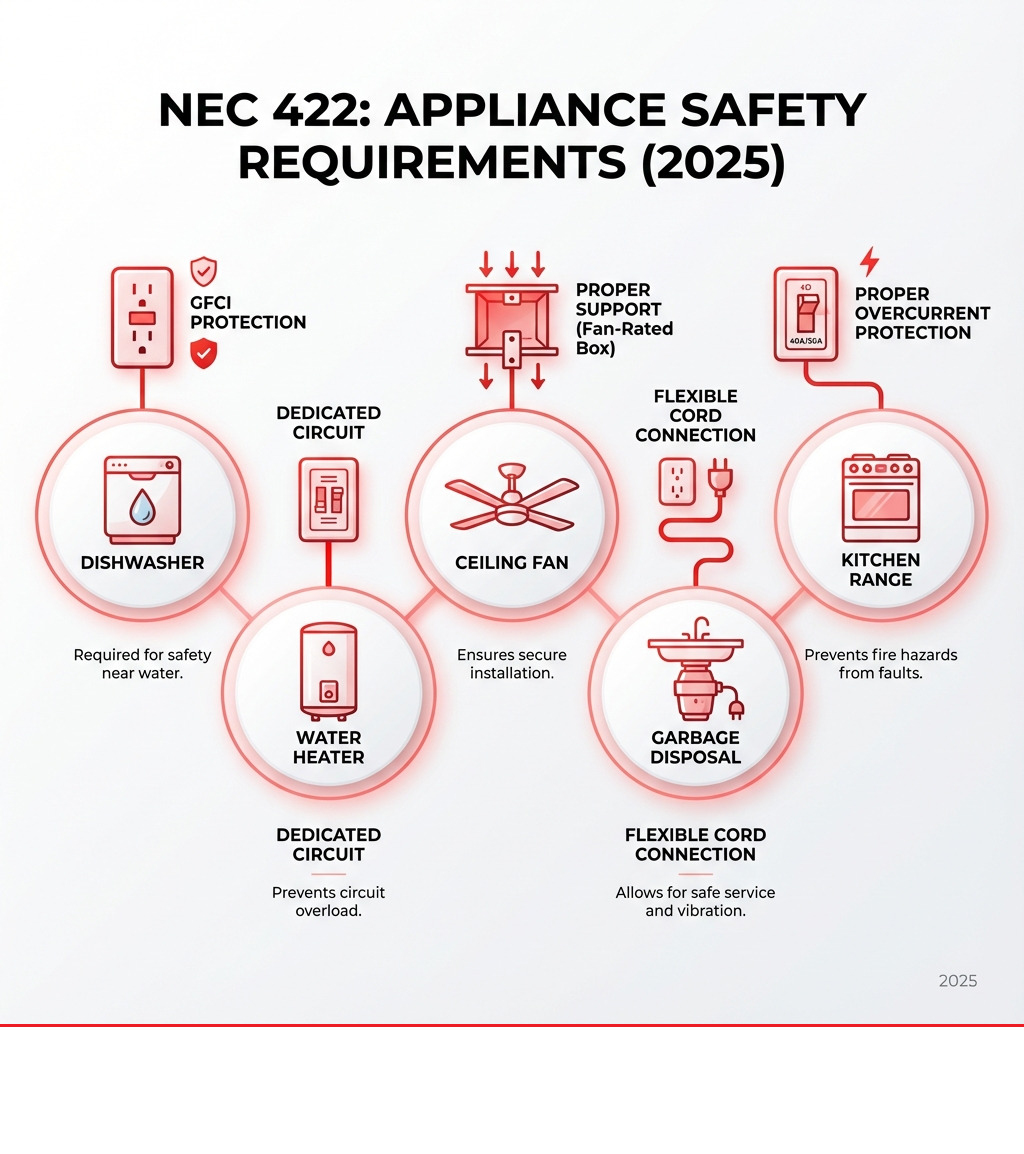
Article 422 isn’t just about passing an inspection. It’s about ensuring your dishwasher has GFCI protection to prevent shocks, your water heater circuit is sized correctly to avoid overheating, and your ceiling fan is supported properly so it doesn’t come crashing down.
In many older Denver homes, I find appliances installed before these rules existed. While not always an emergency, it’s smart to know the current standards, especially if you’re remodeling or adding new appliances.
This guide will walk you through the key parts of NEC 422 in plain English. You’ll learn what to look for and when it’s time to call a professional.
What NEC 422 Covers (And What It Doesn’t)
When we talk about NEC 422, we’re covering a broad range of electrical appliances. The code defines an “appliance” as “utilization equipment, generally other than industrial, that is fastened in place, stationary, or portable; is normally built in a standardized size or type; and is installed or connected as a unit to perform one or more functions such as clothes washing, air-conditioning, food mixing, deep frying, and so forth.”
This wide-ranging definition includes everything from a kitchen range to a portable toaster. The goal of NEC 422 is to ensure these appliances are installed and protected safely.
While Article 422 is comprehensive, it also works with other parts of the NEC. For example, an appliance with a motor, like a garbage disposal, must also follow the rules in Article 430 (motors). Similarly, appliances with hermetic refrigerant motor compressors, like central air conditioning units, also fall under Article 440. This ensures every component of your electrical system is covered. We often handle complex electrical work that involves these overlapping articles.
A fundamental rule in NEC 422 is that appliances over 50 volts must be “listed”—tested and approved by a lab like UL or ETL to meet safety standards. An unlisted appliance is a major red flag. Using listed products is crucial because it confirms the appliance was designed and built for safety, reducing fire or shock risks.
The “Must-Have” Safety Rules: GFCI and Overcurrent Protection
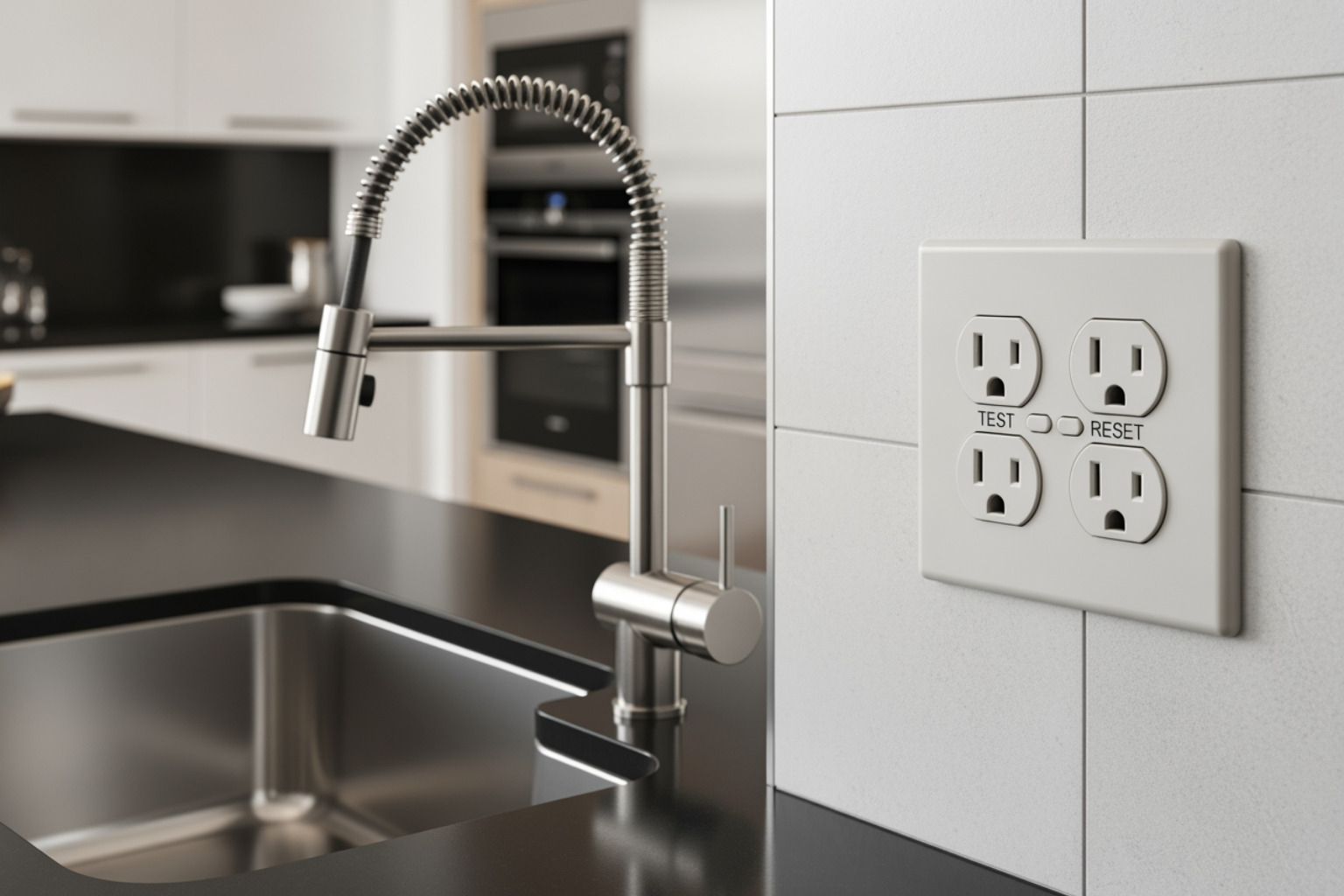
For appliance safety, two key players are Ground Fault Circuit Interrupters (GFCIs) and overcurrent protection. They are your first line of defense against shocks and fires. GFCIs protect people, while overcurrent protection (circuit breakers and fuses) protects wiring and appliances from excess current.
Understanding GFCI Protection for Appliances (NEC 422.5)
For years, GFCIs were mainly for receptacles in wet locations like bathrooms and kitchens, as covered by NEC 210.8. But NEC 422.5 focuses on specific appliances, requiring GFCI protection for personnel no matter how they’re connected. This is a key distinction: 210.8 is about the receptacle’s location, while 422.5 is about the appliance type.
Recent code cycles centralized these GFCI requirements into 422.5, making it clear which appliances need this protection.
So, which appliances require GFCI protection under NEC 422.5? These are typically appliances rated 250 volts or less and 60 amperes or less, which have a higher shock risk. This includes:
- Automotive vacuum machines
- Drinking water coolers and bottle fill stations
- High-pressure spray washing machines
- Tire inflation machines (public use)
- Vending machines
- Sump pumps
- Dishwashers
These appliances require Class A GFCI protection, which trips at a very low level of current leakage (4-6mA). The GFCI can be located in several places:
- Within the branch circuit overcurrent device (a GFCI breaker)
- In a device or outlet within the supply circuit (a GFCI receptacle)
- As an integral part of the attachment plug
- Within the supply cord, near the plug
- Factory-installed within the appliance itself
This flexibility allows for the most practical and safe GFCI location.
Sizing Overcurrent Protection Correctly (NEC 422.11)
Overcurrent protection is essential. It stops wires from overheating and starting a fire if an appliance draws too much current. Your circuit breakers or fuses are like safety valves for your electrical system.
For appliances, the rules for overcurrent protection (OCPD) in NEC 422.11 are straightforward:
- General Rule: The OCPD rating can’t exceed the rating marked on the appliance.
- Non-Motor Appliances (without marked OCPD):
- If rated 13.3 amperes or less, the OCPD shouldn’t exceed 20 amperes.
- If rated over 13.3 amperes, the OCPD shouldn’t exceed 150% of the appliance’s rated current.
- Heating Elements: For appliances with resistance-type heating elements (like ovens), if the total load is over 48 amperes, it must be divided into smaller circuits, each protected at not more than 60 amperes.
- Household Ranges and Cooking Appliances: The branch circuit is usually sized based on specific NEC tables, like Table 220.55.
In Denver homes, I often see overloaded circuits, especially in older houses that can’t handle modern appliances. Frequently tripped breakers can be a sign of an outdated panel. We often recommend a panel upgrade in Castle Rock, CO, and surrounding areas to ensure your home can safely handle today’s electrical demands.
Key Installation Rules for Common Household Appliances
How appliances connect to your electrical system is critical. This involves understanding branch circuits, dedicated circuits, and how “continuous loads” affect wiring size.
Branch-Circuit Sizing for Your Appliances (NEC 422.10)
The branch circuit is the wiring from your panel to the appliance. Sizing it correctly is vital to prevent overheating and ensure the appliance gets enough power. NEC 422.10 provides these rules.
- Individual Appliance Circuits: For a single appliance, the circuit’s ampere rating can’t be less than the appliance’s marked rating.
- Continuous vs. Non-Continuous Loads: A “continuous load” runs for three hours or more (like a water heater). For these, the circuit must be sized to 125% of the appliance’s rating. This safety margin prevents wiring from being stressed by prolonged use. An exception exists for breakers and assemblies listed for 100% continuous loading.
- Multiple Appliances/Other Loads: If a circuit supplies appliances and other loads (like lights), cord-and-plug appliances shouldn’t be rated more than 80% of the circuit rating. Fastened-in-place appliances shouldn’t be rated more than 50% of the circuit rating.
- Ranges and Cooktops: These have their own sizing rules, often using demand factors from the NEC’s Table 220.55.
Getting this right is even more critical for commercial kitchen equipment. We regularly install dedicated circuits for commercial kitchens to ensure they run smoothly and safely.
Central Heating and Water Heaters (NEC 422.12 & 422.13)
These are big power users, so the NEC has specific safety rules for them.
- Central Heating Equipment (NEC 422.12): Central heating generally needs its own individual branch circuit to prevent overloads. Exceptions exist for auxiliary equipment like pumps that are part of the heating system, provided the circuit is sized for the combined load.
- Storage-Type Water Heaters (NEC 422.13): An electric storage water heater of 120 gallons or less is considered a continuous load. This means the circuit must be rated for at least 125% of the water heater’s ampere rating to handle the prolonged demand. Proper wiring is just as important here as it is for hot tubs and spas, where all connections must meet safety standards.
Using Flexible Cords the Right Way (NEC 422.16)
Flexible cords are convenient but not for every situation. NEC 422.16 specifies when and how they can be used safely.
Flexible cords are generally permitted for:
- Frequent Interchange: For portable appliances like a mixer.
- Noise or Vibration Prevention: To isolate an appliance from the building structure.
- Easy Removal: For fastened-in-place appliances that need to be removed for service (like dishwashers or garbage disposals).
For common kitchen appliances, there are specific rules:
- In-Sink Waste Disposers: Can use a flexible cord 18-36 inches long. The receptacle must be accessible and located to protect the cord from damage.
- Built-in Dishwashers: Can use a flexible cord 3-6.5 feet long. The receptacle must be accessible in an adjacent space (like a neighboring cabinet).
- Trash Compactors: Can use a flexible cord 3-4 feet long, with similar receptacle requirements.
- Wall-Mounted Ovens and Counter-Mounted Cooking Units: Can be cord-and-plug connected per manufacturer instructions.
- Range Hoods: Can use a flexible cord 18-48 inches long, connected to an accessible receptacle.
If an appliance surface gets hot (over 250°F), it needs a special “heater cord” to prevent the insulation from melting. The key is that flexible cords are for specific uses, not permanent wiring. We ensure the cord is the right length, the receptacle is accessible and safe, and the cord is protected from damage.
Installing Ceiling Fans Safely (NEC 422.18)
Ceiling fans are great, but they must be installed correctly for safety. NEC 422.18 covers the requirements for ceiling-suspended (paddle) fans.
The most important rule is about support:
- Fan-Rated Boxes: A standard outlet box isn’t strong enough. You need a special “fan-rated” outlet box marked as “acceptable for fan support.”
- Independent Support: Fans over 70 lbs must be supported independently of the outlet box, directly from the building structure.
- Space for Conductors: There must be enough space in the fan canopy and outlet box for all wiring.
- Covering Combustible Material: Any gap between the fan canopy and a combustible ceiling must be covered with noncombustible material.
In bathrooms, metal parts of a fan are prohibited within 3 feet horizontally and 8 feet vertically from the tub rim or shower threshold. This crucial rule prevents electrical contact in a wet environment.
Disconnecting, Construction, and Marking Requirements
Even well-installed appliances need safe servicing. That’s where disconnecting means, proper construction, and clear markings are essential.
The “On/Off” Switch: Disconnecting Means in NEC 422
Every appliance needs a “disconnecting means” to cut power for service or emergencies, as outlined in NEC 422.30. The goal is to disconnect all “hot” wires simultaneously.
- Cord-and-Plug Connected Appliances: For most plug-in appliances, the accessible plug itself is the disconnecting means.
- Permanently Connected Appliances: For hardwired appliances (like a water heater), a dedicated switch or circuit breaker is required.
- Small Appliances (300 VA or 1/8 HP or less): The branch-circuit breaker can serve as the disconnect if it’s within sight of the appliance or can be locked in the “off” position.
- Larger Appliances (over 300 VA or 1/8 HP): A switch or circuit breaker that is either within sight of the appliance or lockable is required. For motor-operated appliances over 1/8 HP, a separate disconnect switch is needed.
- Unit Switches: An appliance’s built-in “on/off” switch can serve as the disconnect if it meets certain criteria.
The “within sight” rule generally means the disconnect must be visible and no more than 50 feet from the appliance, ensuring anyone working on it can easily cut the power.
What to Look for on an Appliance Nameplate (NEC 422.60)
An appliance’s nameplate is its electrical ID card. NEC 422.60 specifies what information it must include. This is critical for safe installation and troubleshooting.
Here’s what you’ll typically find and why it matters:
| Field on Nameplate | What It Means | Why It’s Critical |
|---|---|---|
| Manufacturer’s Name/Model | Identifies who made it and the specific product. | For warranty, parts, and knowing which instructions to follow. |
| Voltage Rating (e.g., 120V, 240V) | The voltage the appliance needs to operate. | Tells us what kind of circuit it needs to be connected to. |
| Amperage or Wattage (e.g., 15A, 1800W) | How much electrical current the appliance draws. | Determines the correct wire size and circuit breaker rating. |
| Frequency (if specific, e.g., 60 Hz) | The electrical frequency it’s designed for. | Standard in the US, but important for specialized equipment. |
| Continuous Load Marking | Indicates if it’s a continuous load (runs 3+ hours). | Triggers the 125% sizing rule for branch circuits. |
| External Motor Overload Protection | If external protection is required (for motor-driven appliances). | Tells us if additional safety devices are needed. |
| Heating Elements (rated > 1A) | Specific ratings for individual heating elements. | Important for proper overcurrent protection and repair. |
| Horsepower Rating (for motors) | The power of any motor in the appliance. | Used for sizing disconnects and overcurrent protection for motor loads. |
This information must be accessible after installation. The nameplate is the first thing we check, as it tells us how to wire the appliance safely and correctly.
Staying Current: Code Changes and Local Rules
The electrical code isn’t static; it’s updated every three years to keep pace with new technology and safety practices. For electricians in the Denver area, staying current is part of the job and key to keeping your home safe.
How Recent NEC 422 Changes Affect You
Recent code cycles, particularly 2020 and 2023, brought important updates to NEC 422:
- Centralization of GFCI Requirements: As mentioned, GFCI rules for specific appliances are now consolidated under NEC 422.5. This means improved shock protection for you from these common devices.
- New Rules for Dishwasher and Trash Compactor Cords: The code now has more specific guidelines for protecting the cords for built-in dishwashers and trash compactors as they pass through cabinets—a common issue I see.
- Evolving Safety Standards: The NEC constantly updates to address new risks, like integrating smart home technology. We’re always learning and adapting, similar to how we stay updated on the latest EV charger requirements to ensure safe and efficient installation.
A Note on Colorado and Denver-Area Rules
The NEC is a national standard, not a federal law. States and local jurisdictions adopt it, often with amendments. While Colorado adopts the NEC, municipalities in the Denver Metro Area like Castle Rock or Parker may have their own specific rules.
For example, local amendments in Castle Rock, CO, might clarify installation practices or require specific permits. You can often find these in their municipal code, such as ordinance no. 2023-037 in Castle Rock.
This is why hiring a local electrician familiar with the Denver area is so important. We know the national code and the specific local rules for permitting and inspections, ensuring your project is both safe and fully compliant.
Frequently Asked Questions about NEC 422
Does my refrigerator need GFCI protection?
This is a common question. Generally, no. The refrigerator itself isn’t listed in NEC 422.5 as requiring GFCI protection. However, its receptacle might need it based on location (e.g., within 6 feet of a kitchen sink, per NEC 210.8). Most refrigerators use a dedicated receptacle behind the unit, which historically hasn’t required GFCI protection.
But the code evolves. Some local jurisdictions expand GFCI rules. If your fridge is in a garage or unfinished basement, the receptacle will need GFCI protection. It’s always best to check with a local pro if you’re unsure.
Can I use an extension cord for a major appliance?
Almost always, the answer is no. Extension cords are for temporary use only. The rules for flexible cords in NEC 422.16 are very specific and refer to heavy-duty, appliance-specific cords, not generic extension cords.
Using an extension cord for a major appliance like a fridge or microwave is dangerous. It can overheat and cause a fire because it’s likely not rated for the current draw. We always recommend installing a proper dedicated circuit and receptacle.
What does it mean for an appliance to be “listed”?
A “listed” appliance has been tested by a Nationally Recognized Testing Laboratory (NRTL) like Underwriters Laboratories (UL) or Intertek (ETL). These labs perform rigorous safety tests to ensure the appliance meets specific standards.
A UL or ETL mark means the appliance passed these tests and is safe for use. An unlisted appliance is a big red flag—it hasn’t been vetted for safety. Using one can pose a significant risk and may even void your home insurance. Always look for the listing mark.
Your Partner for Safe and Compliant Electrical Work
NEC 422 is vital for ensuring your home’s appliances are safe, efficient, and reliable. Following these rules isn’t just about passing inspections; it’s about protecting your family and property from electrical hazards.
At Harmony Electric, we do the job right the first time. As a master electrician serving Denver, Castle Rock, Parker, and the entire metro area, I’m committed to ensuring every installation meets the highest safety standards. We back our work with a lifetime workmanship guarantee on select installations and a three-year material warranty.
If you’re upgrading appliances, remodeling, or want to ensure your home is up to code, we’re here to help. Reach out for residential electrical services in the Denver area. We’ll provide honest recommendations and make sure your home is powered safely.