Getting Started: What to Expect When You’re Installing a Home EV Charger
The average cost of ev charger installation for a Level 2 home charger typically runs between $800 and $2,500 in the Denver area, including the charger unit, labor, and permits. Simple installations at the lower end involve homes with adequate panel capacity and the charger located near the electrical panel. More complex projects requiring panel upgrades or long wiring runs can push costs to $3,000 or higher.
Quick Cost Breakdown:
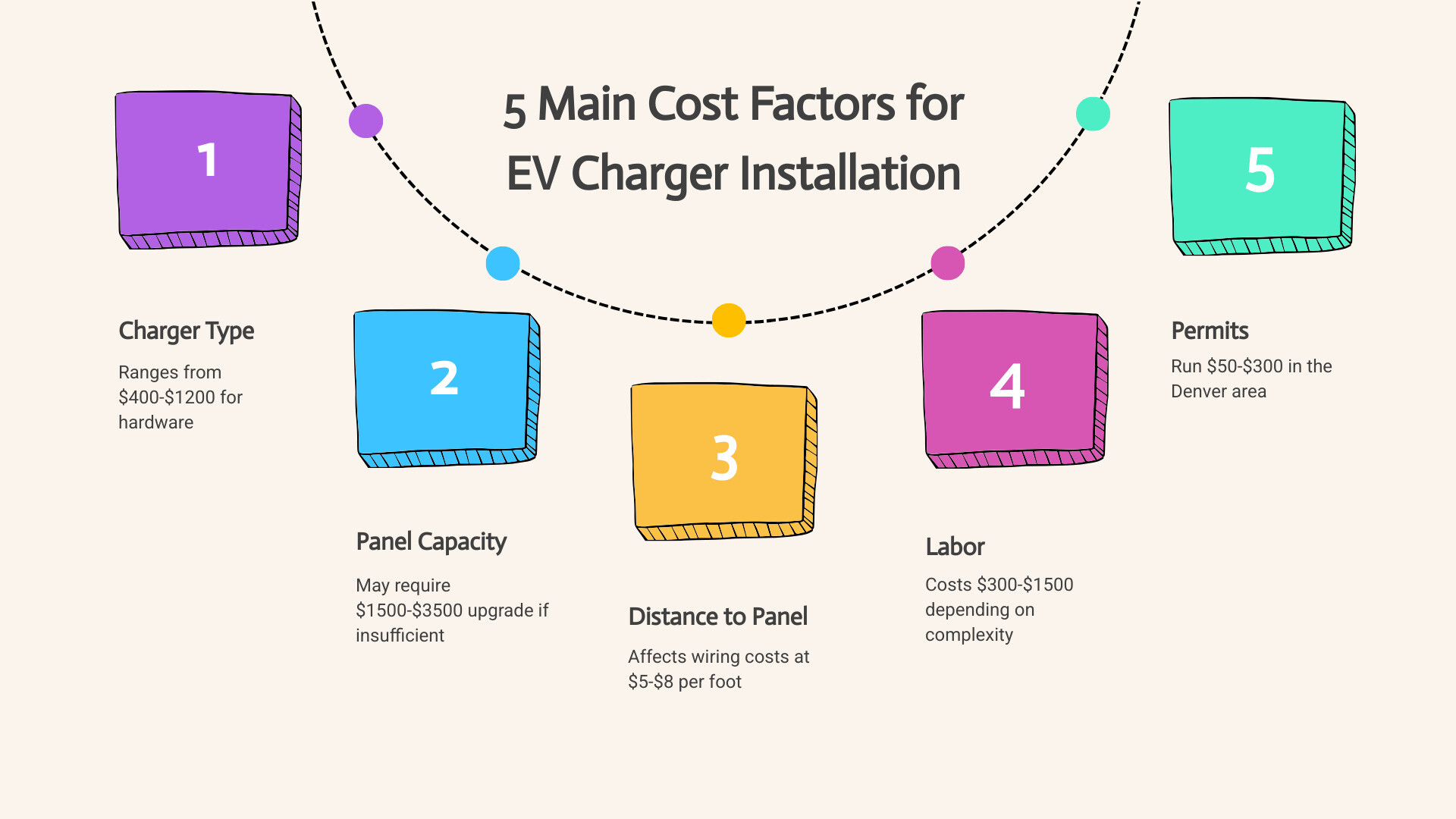
- Charger unit (EVSE): $400 – $1,200
- Electrician labor: $300 – $1,500+
- Permits & inspection: $50 – $300
- Panel upgrade (if needed): $1,500 – $3,500
I’ve installed dozens of EV chargers in Denver-area homes over the years, and the number one question I get is always about cost. It makes sense—you’re already investing in an electric vehicle, and now you need to budget for the infrastructure to charge it at home.
Here’s the thing: there’s no single answer that fits every home. The house I worked on last week in Castle Rock had the panel right in the garage—straightforward job, done in a few hours. The one before that in an older Denver home needed a panel upgrade and 60 feet of wiring through finished walls. Two very different price tags.
What I can tell you is this: installing a home charger is one of the smartest moves you’ll make as an EV owner. You wake up every morning with a full battery, no more sitting at public charging stations, and you’re charging at home electricity rates instead of paying premium prices at DC fast chargers.
In this guide, I’ll walk you through exactly what goes into the cost of an EV charger installation—the equipment, the labor, the permits, and the factors specific to your home that can move the price up or down. By the end, you’ll know what to expect and what questions to ask when you’re getting quotes.
The Main Cost Components: A Simple Breakdown
This section explains what you’re actually paying for when you get a quote.
The EV Charger Unit (EVSE)
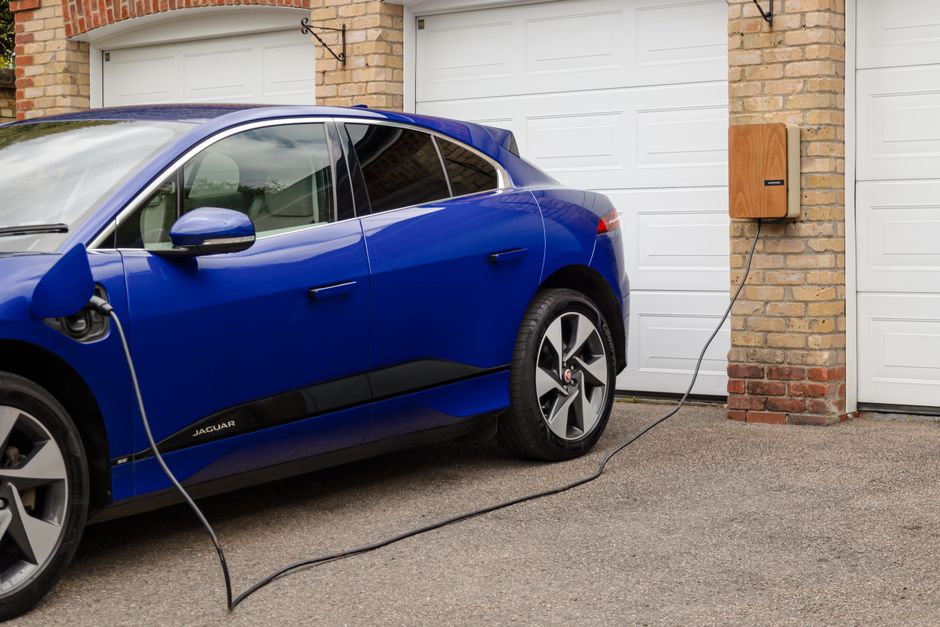
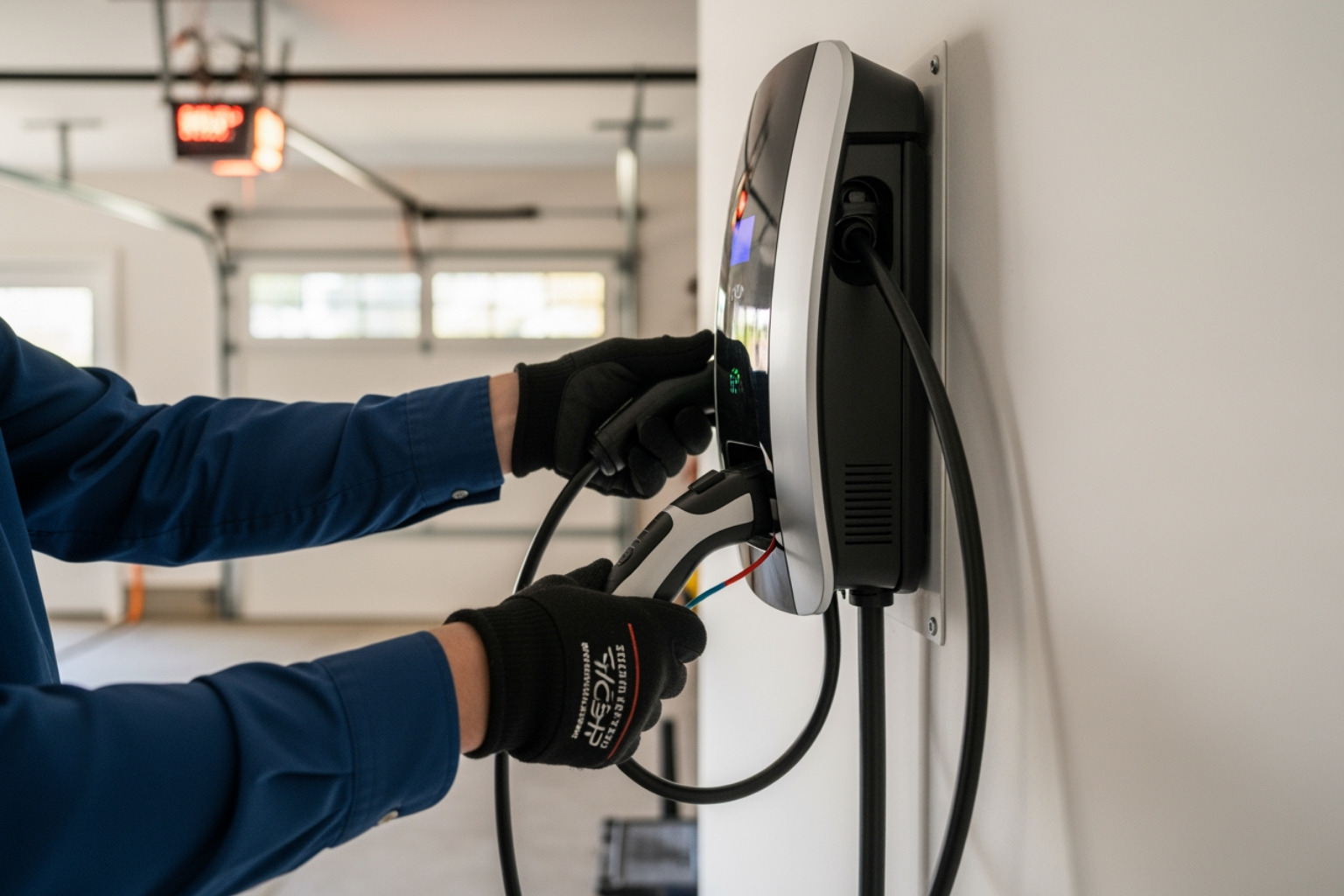
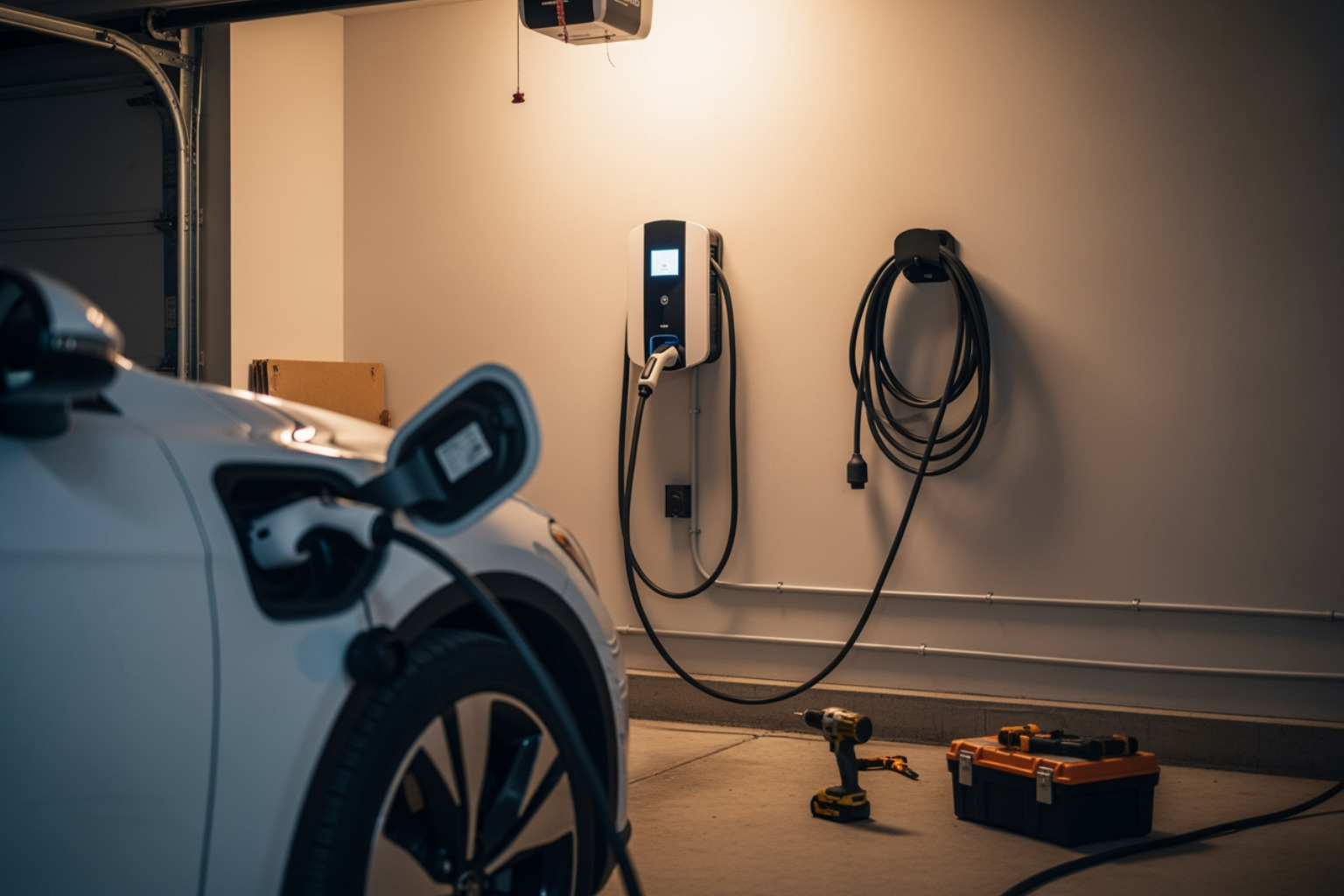
When we talk about an EV charger, we’re usually referring to the Electric Vehicle Supply Equipment (EVSE) — the box mounted on your wall that delivers power to your car. For most homeowners in Denver, a Level 2 charger is the “sweet spot” for home charging.
Level 1 chargers, which just plug into a standard 120V household outlet, are often included with your EV purchase and require no installation. They’re very slow, adding only 3-5 miles of range per hour, which might be fine for a plug-in hybrid or a car that isn’t driven much. But for a fully electric vehicle that’s your daily driver, you’ll soon realize the benefits of upgrading to a Level 2 charger.
Level 2 chargers use a 240V circuit, similar to what your clothes dryer or electric oven uses. These can add anywhere from 12 to 80 miles of range per hour, meaning you can fully charge most EVs overnight. The hardware cost for a Level 2 unit typically ranges from $400 to $1,200. More basic models will be on the lower end, while “smart” chargers with Wi-Fi connectivity, app control, and advanced features can add an extra $200 to $600 to the unit’s price. Some popular brands we see installed in the Denver area include ChargePoint, JuiceBox, and Tesla’s Wall Connector.
You can learn more about the different charging levels in our EV Charger Levels Guide: Home.
The Electrician’s Labor
This is where the magic happens, and frankly, where you want to ensure you’re hiring a qualified professional. Installing a Level 2 EV charger involves working with your home’s main electrical panel, running new wiring, and installing a dedicated circuit and breaker. This isn’t a DIY job, and I’ll explain why in a bit.
The cost of labor for a professional electrician in the Denver Metro Area generally ranges from $300 to $1,500 or more, depending on the complexity of the job. For a straightforward installation where a 240V circuit is already accessible, our team can typically complete the work in just 2-4 hours after permits are approved. This includes carefully running and securing the new wiring, installing the breaker, mounting the charger, and thoroughly testing the system to ensure everything is safe and up to code.
If we need to run new wires a long distance, fish them through finished walls, or perform extensive garage modifications, that time and cost will naturally increase. We pride ourselves on doing the work right the first time, ensuring everything is carefully installed and safety-tested.
Permits and Inspection Fees
I can’t stress this enough: permits are not optional when it comes to electrical work, especially for something like an EV charger that draws a lot of power. In Denver and the surrounding communities we serve, like Castle Pines, Centennial, and Parker, obtaining a permit is mandatory.
Why? Because it ensures your installation meets local building codes and safety standards. A licensed electrician like us will pull the necessary permits from your local building authority. After the installation, an inspector will come out to verify that everything was done correctly and safely. This protects you, your home, and your investment.
Permit and inspection fees typically range from $50 to $300 in our area. Skipping this step might seem like a way to save a few bucks, but it can lead to serious headaches down the road, including potential fines, issues with your home insurance if there’s an electrical problem, or even problems when you try to sell your home. You can check with the U.S. Department of Energy for state laws and regulations regarding EV charging, but always confirm local requirements with your electrician.
Key Factors That Drive Your Installation Cost Up or Down
Every home is unique, and these are the things that have the biggest impact on your final price.
Your Home’s Electrical Panel
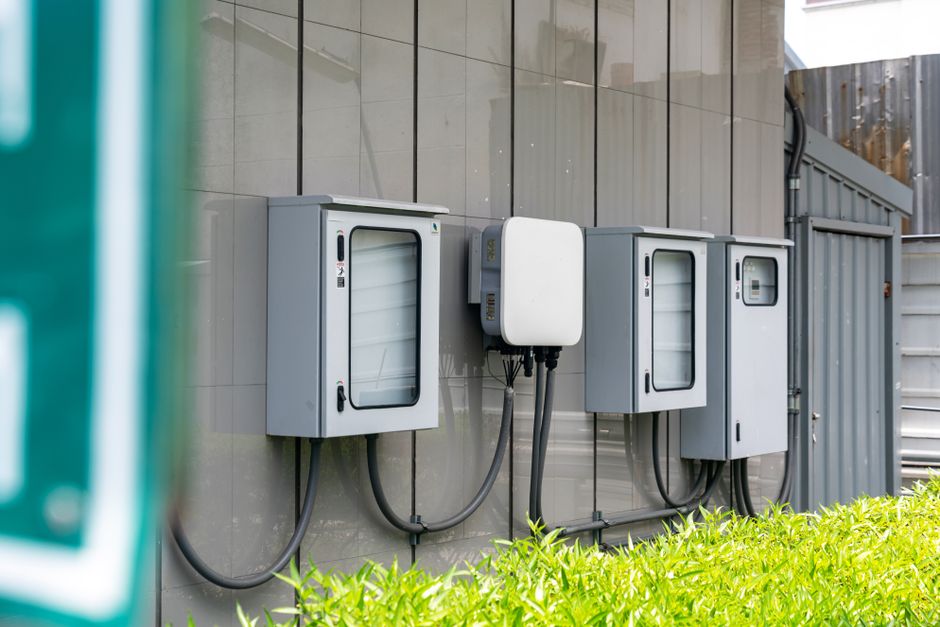
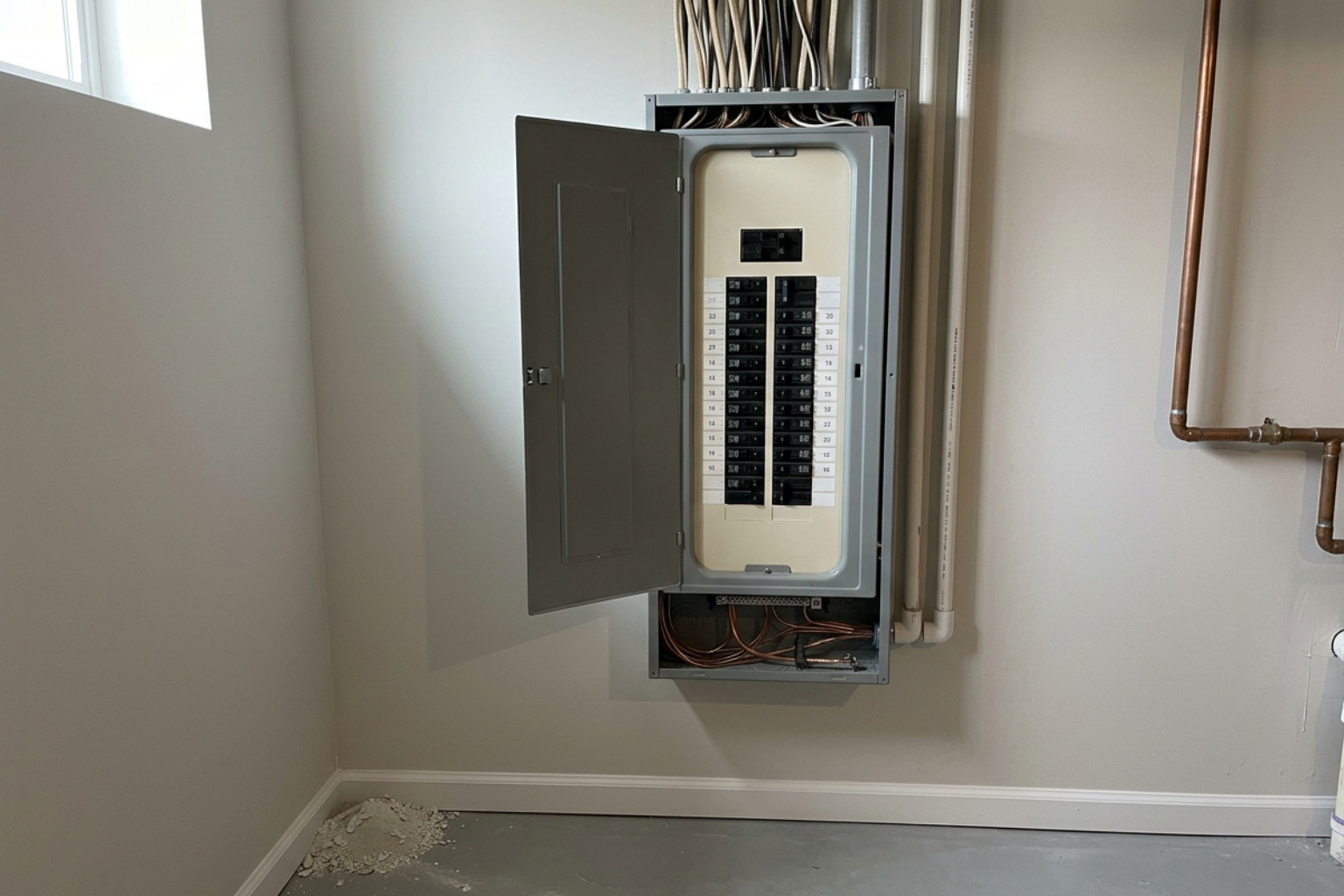
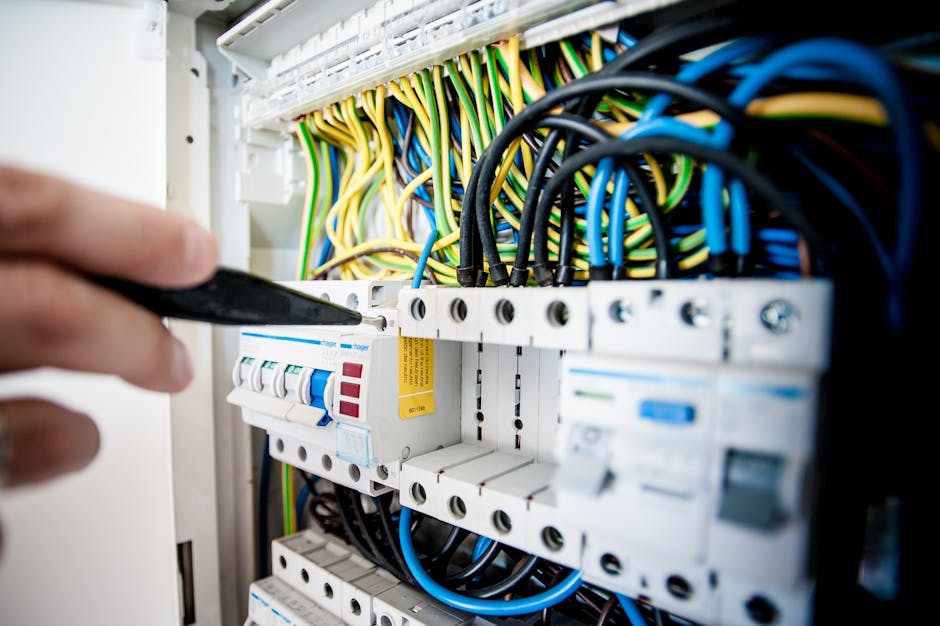
This is often the biggest wildcard when it comes to EV charger installation costs. Your electrical panel is the heart of your home’s electrical system, distributing power to all your appliances and outlets. A Level 2 EV charger draws a significant amount of power – typically between 40 and 60 amps.
Many older homes in Denver, Castle Rock, and Highlands Ranch might have 100-amp electrical panels that are already nearing their capacity. If your panel can’t safely handle the additional load of an EV charger, we’ll need to perform a load calculation to confirm. If it’s truly at capacity, we’ll need to upgrade your electrical panel. This can be a substantial undertaking, pushing the cost up by $1,500 to $3,500, or even more for a full service upgrade.
However, sometimes we can use an EV Management System, which intelligently manages power to your charger, throttling it down if your home’s demand is high. This can sometimes be a workaround to avoid a full panel upgrade, depending on your specific electrical setup and local codes. We always assess your home’s specific needs to find the most efficient and cost-effective solution. You can find more details on panel considerations in our article EV Charger for Your Property.
Distance from Panel to Charger
Think about it: the further your chosen charging spot is from your electrical panel, the more wiring we need to run. More wire means more material cost, and more importantly, more labor time.
If your electrical panel is conveniently located in your garage, and you want the charger right next to it, that’s a dream scenario. But if your panel is in the basement on the opposite side of the house from your garage, or if you want the charger outside on the driveway, the costs will increase.
Running wire through an unfinished basement or attic is usually pretty straightforward. But if we need to fish wires through finished walls, ceilings, or even trench underground to a detached garage, the labor involved goes up significantly. Expect to pay anywhere from $6 to $12 per linear foot for wiring, and conduit runs over 50 feet can add $5-$8 per foot. If trenching is involved for an outdoor or detached garage installation, that adds another layer of complexity and cost.
Charger Amperage and Connection Type
Level 2 chargers come in various amperages, from 16A to 80A. The higher the amperage, the faster your car charges, but also the more power it demands from your home’s electrical system.
Most residential chargers are rated for 40A or 50A. A 50A charger, for instance, requires a 60A circuit breaker (because the breaker needs to be 125% of the continuous load). If your panel is already tight on capacity, sometimes choosing a slightly lower amperage charger, like a 40A unit that only needs a 50A breaker, can help you avoid a costly panel upgrade. It might mean your car charges a little slower, but it could save you thousands upfront.
You also have a choice between a “plug-in” charger (which uses a NEMA 14-50 outlet, like an RV plug) or a “hardwired” charger. Hardwired installations are generally less expensive, ranging from $850 to $1,800, compared to plug-in installations which can be $1,000 to $2,200. While installing a NEMA 14-50 outlet costs between $50 and $800, some municipalities in Colorado actually require Level 2 chargers to be hardwired for safety reasons. We always recommend checking what’s best for your home and local regulations. For more on charging power, check out our piece on a 7kW Home Charging Point.
The National vs. Denver Average Cost of EV Charger Installation
Let’s talk numbers. Here’s a look at typical costs, from simple to complex projects.
What a “Simple” Installation Looks Like
I love these jobs because they’re quick, efficient, and cost-effective for the homeowner. A simple installation usually means:
- Your electrical panel has plenty of spare capacity.
- The panel is located in your garage, right where you want the charger.
- The wiring run is short and easy, perhaps just a few feet.
- You’re choosing a standard Level 2 charger.
In this best-case scenario, the total cost, including the charger unit, labor, and permits, typically falls in the $800 to $1,500 range. We can often get these done in just a few hours, leaving you with a fully functional charger the same day.
What a “Complex” Installation Involves
Now, let’s look at the other side of the coin. A complex installation is where the average cost of ev charger installation starts to climb. This might involve:
- A full electrical panel upgrade because your existing panel can’t handle the new load.
- A very long wiring run across your entire house, through finished walls, or even across different floors.
- Trenching underground to power a charger in a detached garage or an outdoor charging spot.
- Installing load-shedding equipment if a panel upgrade isn’t immediately feasible.
Projects like these require significantly more labor, materials, and planning. The cost can range from $2,000 to $4,500+, depending on the specifics. For example, an older home needing a panel upgrade and a 40-foot wire run could easily reach around $2,600. It’s important to understand these factors upfront so there are no surprises.
Understanding the average cost of ev charger installation in Colorado
When we talk about the average cost of EV charger installation in Colorado, specifically in the Denver Metro Area, we find it generally aligns with national averages, though specific labor rates can vary. Our local labor rates here in Colorado are generally competitive.
As mentioned earlier, permits are mandatory across Colorado. We handle the permitting process for our clients in Denver, Castle Rock, Centennial, and all the communities we serve, ensuring compliance with local regulations. While the typical range for a Level 2 charger installation in Colorado is $800 to $2,500, complex projects can certainly exceed this.
For specific details on how costs can break down in your area, you can look into resources like our EV Charger Installation in Castle Rock, CO page, which provides more localized insights.
How to Save Money on Your EV Charger Project
An installation is an investment, but there are ways to lower the upfront cost.
Federal, State, and Utility Incentives
This is one of the best ways to reduce your out-of-pocket expenses for an EV charger. Both federal and local incentives can significantly cut down the cost.
The federal government offers a tax credit for alternative fuel vehicle refueling property. This means you could get a tax credit for 30% of the cost of your EV charger equipment and installation, up to a maximum of $1,000. This credit is available until June 30th, 2026, and possibly through 2032, so it’s a great opportunity! You can find more information about this federal tax credit from the 30% federal tax credit information from the DOE.
Beyond the federal level, check with local utilities like Xcel Energy. Here in Colorado, Xcel Energy and other local utilities sometimes offer rebates that can be stacked with the federal tax credit, potentially saving you up to $1,300. Always apply for utility rebates first, as the federal tax credit is usually calculated on the remaining cost after other rebates. We can help you steer these options.
Smart Choices to Reduce Costs
Beyond incentives, there are some smart decisions you can make during the planning phase to keep costs down:
- Place the charger near the panel: As we discussed, every foot of wiring adds to the cost. If you can position your charger in the garage, close to your main electrical panel, you’ll save significantly on labor and material costs.
- Choose a charger with adjustable amperage: Some Level 2 chargers allow you to adjust their maximum amperage. If your electrical panel is borderline, setting your charger to a slightly lower amperage (e.g., 40A instead of 50A) might avoid the need for a full panel upgrade, which is a huge cost-saver.
- Bundle with other electrical work: If you’re already planning a garage renovation, an electrical panel upgrade, or other major electrical work, ask us about bundling the EV charger installation. We can often save you money on labor by combining tasks and minimizing multiple service visits.
Frequently Asked Questions about Home EV Charging
Here are a few questions I get all the time from homeowners in the Denver area.
Can I install an EV charger myself?
This is a firm “no” from us. While Level 1 chargers can plug into a standard outlet, Level 2 chargers require a dedicated 240V circuit and connection to your main electrical panel. Working with live electrical panels is extremely dangerous and should only be done by a licensed and insured electrician.
Attempting a DIY installation can lead to:
- Safety risks: Electrocution, fire hazards, and damage to your home.
- Electrical code violations: Improper installations won’t pass inspection and can lead to fines or require costly rework.
- Voiding warranties: Both your charger’s warranty and potentially your home’s electrical system coverage could be voided by unlicensed work.
- Insurance issues: Your home insurance might not cover damages or injuries resulting from unpermitted or improperly installed electrical work.
For your safety and peace of mind, always hire a licensed professional.
Does an EV charger add value to my home?
Absolutely! Installing a Level 2 EV charger is a smart investment that can definitely add value to your home. As electric vehicles become more common, an EV charger is transitioning from a niche amenity to a highly desirable feature for homebuyers.
Homes equipped with EV chargers tend to sell more quickly and often at a premium. It signals that your home is modern, energy-efficient, and future-proofed, appealing to a growing segment of buyers who prioritize sustainability and convenience. It’s like having central air conditioning or an updated kitchen — it improves your property’s appeal and marketability, especially in a forward-thinking market like Denver.
How long does the installation take?
For most standard Level 2 EV charger installations, where your electrical panel has sufficient capacity and the charger is located in a convenient spot like a garage, our team can typically complete the job in 2 to 4 hours after the necessary permits have been secured.
However, if your project is more complex — requiring a panel upgrade, a very long wiring run, or trenching — the installation time could extend to 1 to 3 days. When we provide you with a quote, we’ll give you a clear estimate of how long your specific installation will take, so you know exactly what to expect on installation day.
Ready for Your Own Home Charging Station?
The final cost of your EV charger installation depends on your specific home, but it’s an investment in convenience that pays off every morning. The only way to get a firm price is to have a qualified electrician take a look. At Harmony Electric, we back our EV Charger Installation work with a lifetime workmanship guarantee, so you know the job is done right.